Almost any discussion of positioning, that is, the place a brand occupies in the customer’s mind, soon reaches the word “differentiation”. Before differentiation comes a simpler question: does the customer consider you at all?
A customer choosing a product has two questions in mind, even if they never say them aloud. The first is “Is this the kind of product I’m looking for?”, and the second is “Why this one?”. Each question needs a different answer.
Two questions, two kinds of argument
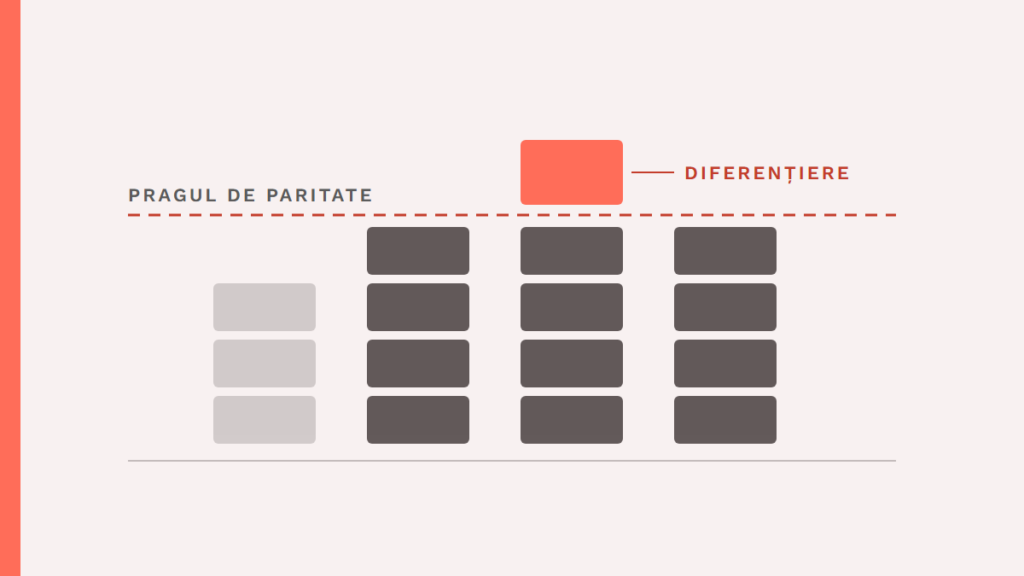
Points of parity answer the first question. They are the things you must have to enter the category. Without them you do not reach the customer’s shortlist.
Points of difference answer the second question. They are the reasons the customer chooses you, once they have accepted that you are an option. The real competition only starts here.
Kevin Lane Keller, Brian Sternthal and Alice Tybout set the two notions side by side in a Harvard Business Review article in 2002. Their idea is that good positioning has both, each written separately.
Parity is the entry ticket
Think of a bank with no phone app. The customer rules it out before comparing its interest rates or advice with those of other banks. The bank loses on parity.
Parity has at least two forms. The first belongs to the category: what the customer expects from any product of that type, for example internet in a hotel room. The second belongs to competition: you cancel out the advantage a competitor claims, so that it no longer weighs in the choice.
With parity, it is enough to cross the threshold: be good enough that the customer does not eliminate you from the comparison. The effort beyond the threshold is better spent on differentiation.
Differentiation must matter to the customer
A point of difference needs three things to work: the customer must want it, believe it and not find it just as good elsewhere. If one is missing, the difference remains a sentence in the company presentation.
One of the ideas I repeat often helps here: “Customers buy the progress they make with a product. The product is only the road.” A technical feature becomes a point of difference only when it helps the customer make progress. Otherwise only engineers notice it.
This is also where the most common mistake comes from. The company picks a difference it can measure, for example the number of functions, while the customer chooses on a difference they feel, for example the time they lose.
The Volvo example: a difference handed to the competition
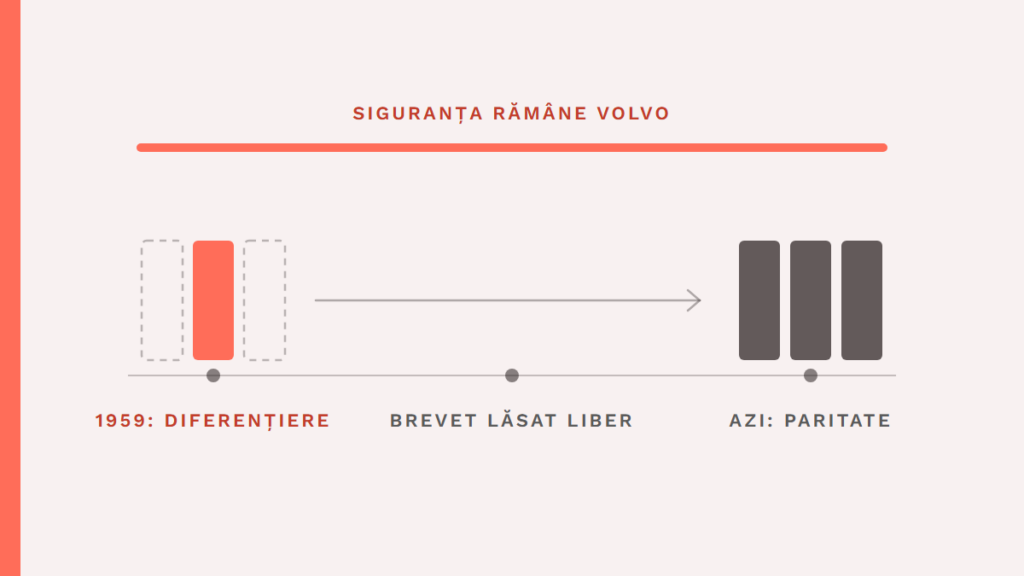
In 1959, Volvo put the three-point seat belt, designed by the engineer Nils Bohlin, into series production. The belt held both the pelvis and the chest, and the person fastened it with one hand. At the time, it was a clear point of difference.
Volvo then chose to leave the patent open, so that any manufacturer could use the invention without paying a licence. Over time, the three-point belt thus moved to parity. Today a car without it is not even considered.
The link between Volvo and safety lasted for decades all the same. The company kept working on safety and talking about it, from crash tests to automatic braking systems. The difference stayed tied to the customer’s progress: you get home in one piece, with your family in the car.
A feature can be copied or can become standard, but a theme a brand supports for years is harder to move. Volvo lost the exclusivity of the belt and kept its place in the customer’s mind.
The border between parity and differentiation moves
What was differentiation ten years ago may be the minimum entry condition today, as happened with card payment in taxis or parcel tracking in online retail. The change comes without announcement. The customer raises the bar as the whole category reaches it.
More rarely, it happens the other way round too. Something the whole category has given up can become a point of difference again, for example a person who answers the phone when all competitors have moved to forms.
That is why it is worth redoing the parity list and the difference list periodically, for example once a year or when a new competitor enters the market. The working question stays the same: what does the customer expect from anyone, and what do they expect only from you? The answer changes faster than the written strategy.
How to tell them apart in your strategy
Collect everything your company says today about its product on the website, in offers and in client presentations. Put each claim in a list, one per line. The list will be longer than you think.
For each line, ask yourself one question. If a competitor said exactly the same thing, would the customer still have a reason to choose you? If the answer is no, the claim is parity.
From what remains, keep only the claims you can prove and that show how you help the customer make progress. The rest are product details, useful in the technical offer. You usually end up with one or two points of difference.
Then check the parity list from the customers’ side too. Ask five customers what they consider mandatory in a product like yours and compare their answers with your list. A missing point of parity costs more than a weak difference.
What to remember
Parity earns you the right to be compared, and differentiation makes the customer choose you. You need both, written separately and checked with real customers. Without them, a campaign has little to say.
Order matters too: “A brand is clarified before any campaign.” Clarification starts with the two lists above.
Brand Mentors
I work with companies through Brand Mentors
There I do brand strategy and consulting, starting from consumer psychology. You will find the services on brandmentors.ro.
Go to Brand Mentors