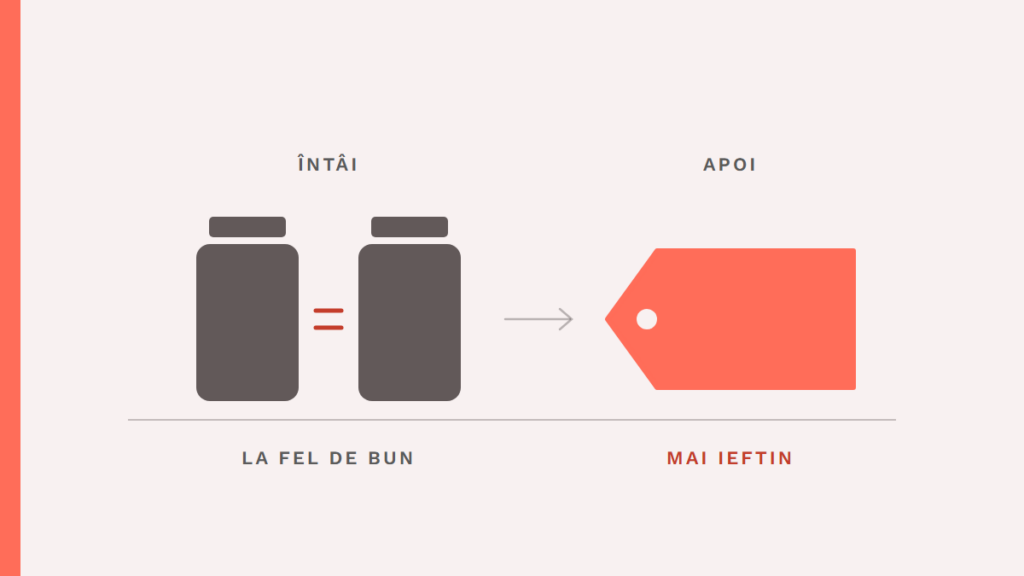
You say you are as good through proof the customer can check, and you state the difference only after that, briefly. Aldi did it in four words: “Like Brands. Only Cheaper.” In other words, the same as the big brands, only cheaper.
The sentence splits the work in two halves: the first tells the customer they lose nothing, and the second tells them what they gain if they switch shops.
1. The problem with a low-price shop
A low-price shop has a problem that price alone does not solve, because a customer can read a low price as a sign of poor quality. Then the price works against you.
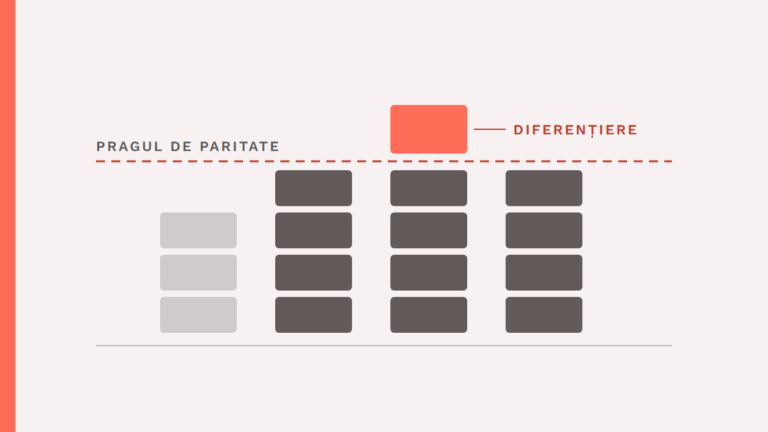
In the language of the trade, quality comparable to the well-known brands is a point of parity, meaning what you need in order to enter the category. The low price is the point of difference, what gets you chosen within the category. Without the first, the second never reaches the customer.
I explain both ideas at length in the article on point of parity and point of difference. Here I look at a case where a company said both in the same sentence and kept it that way for years.
2. The 2011 proof
In September 2011, Aldi announced the results of a study it commissioned from Manchester Metropolitan University, comparing the shop’s own brand with the leading brands. The study covered eleven everyday products. They included cereal, bread, tea, lemonade, ketchup and baked beans.
The 50 participants tasted the products without packaging and without knowing where each one came from, then rated appearance, smell, taste, texture and overall impression. Each pair had one Aldi product and one branded product. The university ran the differences through a statistical analysis.
According to the press release, 91% of the Aldi products tested came out as good as the big brands, and 27% scored significantly better. Only one brand was clearly preferred, Kellogg’s Special K. The release also worked out the saving: £14.27 per shop, for anyone switching from the leading brands to the eleven Aldi products.
Aldi commissioned the study, so you read it as proof offered by an interested party, with the method on display. Tony Baines, Aldi’s buying director, summed up the conclusion in the same words as the slogan: “Aldi’s products are like brands, only cheaper.”
3. The comparison becomes the form of the ad
The campaign started in 2011 and, according to Prolific North’s account from 2019, used ordinary people instead of actors to say one thing: Aldi products are as good as the branded alternatives. The May 2019 ad, for example, put Aldi sun cream next to Nivea cream bought at Tesco.
The ad showed the comparison on screen and left the conclusion to the viewer. The Cannes Lions archive also lists a 2018 film from the same campaign, “Room Spray”, signed by the agency McCann Manchester.
In October 2019, the campaign created by McCann Manchester won the Grand Prix at the Effie Awards Europe, and McCann Worldgroup was named agency of the year. The award belongs to the agency and its client. For our subject, the award shows that the order in the slogan held up through eight years of advertising.
4. Why parity comes first
A customer walking into a low-price shop already has a suspicion about quality, and a message that says only “cheaper” confirms it. Parity answers the fear first, and only then does the price become a reason to switch.
The order matters for another reason: parity needs proof, whereas the price difference is visible on the shelf. Aldi put the proof first in the study, then in the filmed comparisons.
The rule I suggest for this subject goes like this: “The customer puts you on the list for what you have in common with the others, and chooses you for what only you have.”
The 2011 release admits that Special K won the comparison. Proof that admits a loss makes it easier to believe the rest of the results, because it shows the test could have gone badly.
5. How to use this order in your own business
Start with the suspicion your difference brings with it, because almost every advantage comes with a matching fear in the customer’s mind. A low price brings the fear of poor quality. Speed brings the fear of rushed work.
Say you have a furniture workshop that delivers in two weeks, when others deliver in two months. The customer hears “two weeks” and thinks of boards cut in a hurry and weak joints. The right proof for them is a visit to the workshop or a written guarantee on the joints, which you show them before the delivery date.
Then look for proof the customer can check alone, without taking your word for it. It can be a test done by someone else, a comparison you show openly or a written guarantee. The proof must match the fear named in the first step.
Only after that do you state the difference, as briefly as possible, in a form the customer can repeat to someone else. At Aldi, the difference fitted into a single word, “cheaper”, and the rest of the slogan worked for parity.
A simple test for your message: read it through the eyes of a customer who does not know you and ask yourself what suspicion is left after the first sentence. If the suspicion is exactly the one your difference brings, you have put the order the wrong way round.
What to remember
An advantage reaches the customer only after the fear it brings has been answered. Aldi proved parity with a study and filmed comparisons, and stated the price in one word. Name the fear your advantage brings and put the proof for it ahead of the advantage.
Brand Mentors
I work with companies through Brand Mentors
There I do brand strategy and consulting, starting from consumer psychology. You will find the services on brandmentors.ro.
Go to Brand Mentors