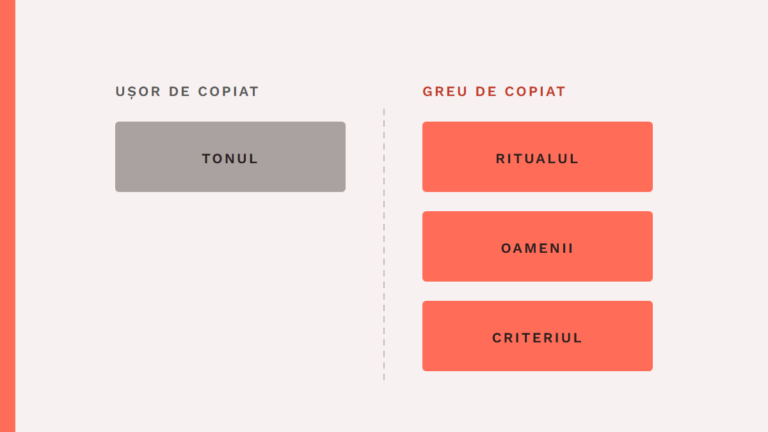
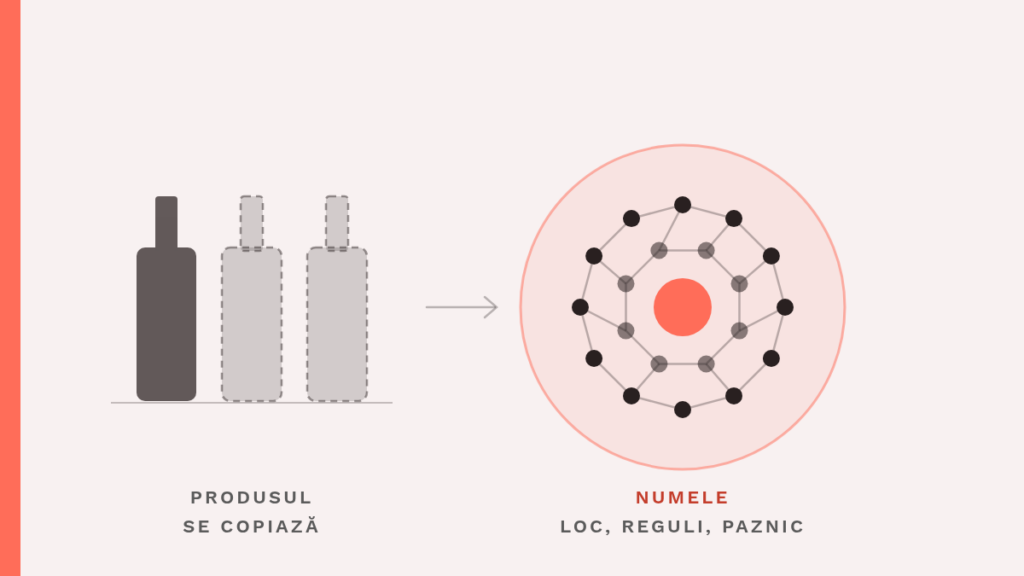
When the product is easy to copy, the brand rests on what does not leave with the recipe: the place, the rules you follow in plain sight and the people who defend them alongside you. Champagne is the classic case.
Good sparkling wine is made in many countries today. The word on the label stays with a single region of France. The case shows, piece by piece, how to build a competitive advantage (the reason the customer chooses you and the competitor cannot quickly take it from you) that does not sit in the product.
1. The part that gets copied
The product can be imitated. The association of the Champagne houses tells how, from the middle of the nineteenth century, producers from outside the region began to put the name on their wines, so the houses asked that “Champagne” stay only with wines made there.
The problem is more than a hundred years old. When someone pours two sparkling wines into a glass, at a wedding, after midnight, few guests can still tell which is which, however hard a winery worked on the difference between them. Then it no longer matters who invented the method.
Many Romanian firms live the same scene, without the wedding. The product is good, the competitor rebuilds it quickly and the client sees two offers on the table that look the same. The difference in quality exists, but it cannot be seen from the distance at which the client decides.
2. How the name became tied to a place
The region first put a border on the map. Comité Champagne, the joint body of the growers and the houses, sums up the road in four steps: the administrative delimitation of the vineyard in 1908, the judicial delimitation in 1919, the delimitation by law in 1927 and the production conditions in 1935.
On 29 June 1936, Champagne received the status of Appellation d’Origine Contrôlée (AOC), a controlled designation of origin. From that moment, the name belongs to a place and a set of written rules. How long did the road take? Twenty-eight years.
For an entrepreneur, the lesson is patience: an advantage tied to a place is built over decades, with documents, lawsuits and negotiations that a competitor in a hurry has no wish to repeat from scratch.
3. The rules everyone keeps
The border alone stops nobody from making bad wine inside it. Comité Champagne lists what else the appellation requires: eight authorised grape varieties and one accepted for adaptation, four methods of pruning the vine, annual limits on production per hectare, a limited yield at pressing and minimum ageing periods in the cellar.
Taken separately, every rule can be copied. Any winery in another country can pick the same varieties, prune the vine the same way and keep its bottles in the cellar as long as it likes. What is hard to reproduce is the number of people who keep them all at once.
According to the figures published by Comité Champagne, the rules are kept by 16,460 growers, 120 cooperatives and 410 houses, on 34,200 hectares across 319 villages. A competitor can buy a hectare of vineyard and hire a good oenologist. They cannot buy the agreement of thousands of people who work by the same written rules.
A competitor copies an activity easily. They copy with difficulty the way your activities hold one another up. I wrote at more length about the difference between an activity and a system.
4. Who defends the name
The rules need a guardian. Since 1941, Comité Champagne has defended the shared interests of the houses and the growers. The law of 12 April 1941 gives it the right to go to court.
On its site, the committee says it fights every form of counterfeiting, imitation or abusive use of the name, which today is recognised, according to its pages, in more than 120 countries. The stakes are high: in 2025, the region shipped 266.1 million bottles.
Here lies the difference from a trademark defended by a single firm, with a single lawyer and a single budget. When the protection is backed by everyone who lives from the name, nobody has an interest in letting it weaken, because an imitation costs them all.
5. What you can take from this for your firm
The mechanism has a Romanian version too. By Implementing Regulation No 338/2011 of 7 April 2011, the European Commission entered “Magiun de prune Topoloveni” in the register of protected geographical indications (PGI), the names that tie a product to the place it comes from.
You may not have a product that could enter such a register. The idea can still be borrowed on a small scale, in three questions you ask about what you sell today, before you write one more ad about quality.
The first question: to what place, to what people or to what history is your product tied, in a way a competitor from another town cannot move to themselves? The second: what rules do you keep publicly, written down and easy for the client to check, that a competitor in a hurry would find too expensive or too slow?
Say you have a bakery that bakes only with flour from two mills in the county and writes their names on the door. The competitor across the street can imitate your bread in a few weeks, with a good baker and a new oven. The mills are another story: to take them, they must convince them to work with them, which takes years of trust.
The third is hard. Who defends the rules alongside you: an association of producers, a certification, a group of clients who notice at once when someone cheats and say so out loud?
The answers are not written in a meeting. They are found in what you have already been doing for years, sometimes without telling anyone. Advantages like these usually sit beneath what shows in the ad, in the structure of the firm.
What to take away
At Champagne, the method can be imitated anywhere, yet the name stays tied to a place, to rules that thousands of people keep at once and to a committee that defends them in court. That was hard to build. Look in your own firm for what does not leave with the recipe.
Brand Mentors
I work with companies through Brand Mentors
There I do brand strategy and consulting, starting from consumer psychology. You will find the services on brandmentors.ro.
Go to Brand Mentors