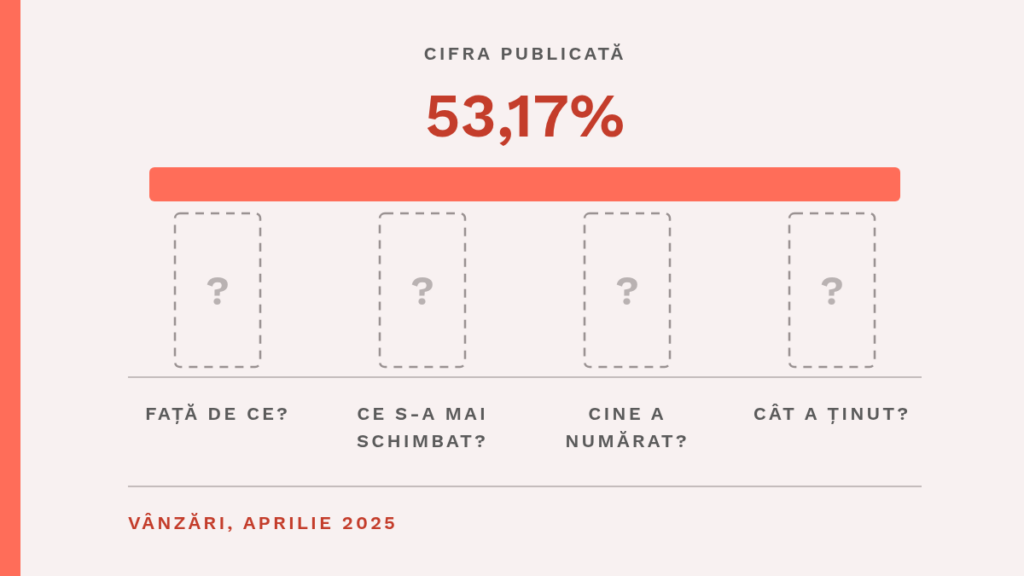
A figure from an award-winning case is worth as much as the questions it survives: compared with what, what else changed in the same period, who counted, and how long the effect lasted. Until you ask them, you are holding a claim.
My example is the campaign that won the Grand Effie at the 2026 Effie gala in Romania. It is a campaign about fact-checking, so I read it with the care it asks for.
1. The case: a book for every fake news story
In April 2025, the Romanian bookseller Cărturești and the agency VML Romania launched “The Book Fact Checker”. The team looked for false or distorted news on seven topics: climate change, medicine, psychology, history, geography, technology and economics. They used artificial intelligence and social listening, the systematic tracking of what people write on social networks and websites.
For each fake story, an online banner recommended a book on the subject. The banners led to a dedicated page on the Cărturești site, where non-fiction books on the seven topics sold at a reduced price throughout April.
Bogdan Teodorescu, executive creative director at VML Romania, explained the idea in Revista Biz: a fake news story can appear from nowhere and go viral in an instant, with nobody checking it. The book sits at the other end, with “months or even years of work, corrections, checks, sources and serious research”.
The Grand Effie was one of 49 awards handed out at the 2026 gala, which honoured 20 agencies.
2. What the published figures say
Revista Biz published the results on 12 May 2025, in an article built on statements from Cărturești and VML. Sales of the promoted books rose by 53.17%, sales value by 50.91%, and the perception of books as a valuable source of information by 35%.
The sentence with the figures ends in an asterisk, but the page shows no note to explain it. The article also leaves out who measured: the client, the agency or a research institute. The figures may be correct, and you would still have nothing to judge them with.
You start reading an award-winning case with a comfortable belief: the jury gave the prize, so the figure is good. A marketing belief becomes a fact only after you have tried to contradict it. The attempt takes four questions.
3. Four questions for an award-winning figure
1. Compared with what?
A 53.17% rise needs a starting point: April of the previous year, March, or an average over several months. Each option tells a different story, and the article does not say which one the team chose. Ask for the comparison period before you read the percentage.
2. What else changed that month?
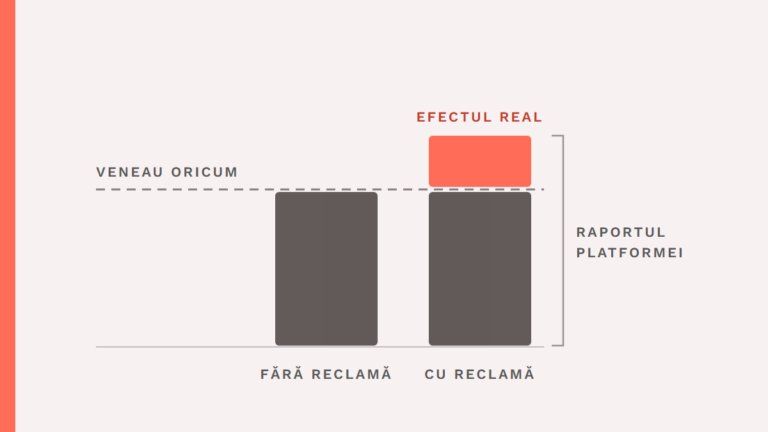
In April, the promoted books had banners and a reduced price at the same time. A discount can lift sales on its own, so the published figure does not let you separate the effect of the banners from the effect of the price.
The two sales figures show that volume grew slightly faster than value, so the average price per book sold came down slightly. They do not show how many buyers came for the discount and how many for the recommendation. I wrote about the comparison missing here in the article on how to tell if a marketing spend brings anything: you need an area or a period without the campaign, measured the same way.
3. Who counted, and how?
The 35% figure is the hardest of the three to read. You usually measure perception with a survey, and a survey has an exact question, a number of respondents and two measuring points, before and after. The article gives none of these details.
Then there is the arithmetic: 35% can be a rise relative to the starting value or 35 extra percentage points. The two readings describe very different results, and without the starting value you cannot tell which one to pick.
4. How long did it last?
The sales figures cover the campaign month, with the discount in force. You still need to find out what sold after the discount ended, and whether the people the banners brought in bought anything else from the bookseller in the following months.
4. What to do when the press page gives no answer
Look for a source closer to the data: the case presentation on the agency’s site, an interview with the client’s marketing lead, or a case study from the organisers. If you find nothing, write to them and ask about the comparison period and the method.
If you still get no answer, you can go on using the figure, with its label. Write “stated by the client” or “stated by the agency” next to the percentage, with the date and place of publication. Whoever reads after you then knows how far to rely on it.
5. How to use an award-winning case in your company
From an award-winning case, take the mechanism first. The idea of answering a fake story with a book can move to other categories: a supplement maker can answer a nutrition myth with a doctor’s explanation, and a software company can answer a technical rumour with its documentation.
Treat the figure separately. If you put it in a presentation for shareholders or for the finance director, write next to it the comparison period, the source and what else changed that month.
Your own figures deserve the same treatment when you take them to the budget meeting. The same problem shows up in the Tropicana packaging case, where a fall in sales does not show on its own what caused it.
What to remember
A figure from an award-winning case tells you something only after you learn what it was measured against, what else changed at the time, who counted and how long the effect lasted. Keep the mechanism from the case, and use the figure with its source label beside it.
Brand Mentors
I work with companies through Brand Mentors
There I do brand strategy and consulting, starting from consumer psychology. You will find the services on brandmentors.ro.
Go to Brand Mentors