First check how work flows through your company, and choose the AI tool after that. Anyone can buy the subscription, at the same price, on the same day. The way your work is organised can’t be bought anywhere.
The idea comes from the “Frontier CMO” report, written by Google from the interviews in the podcast of the same name. The source sells AI and YouTube. The figures in the report are declared by the companies that appear in it, with no public methodology, and I cite them as their claims.
1. What Carla Hassan, of JPMorgan Chase, says
Carla Hassan leads marketing at JPMorgan Chase, a heavily regulated institution. When her teams got their first generative AI tools, she refused to fold them into the daily routine right away. The report quotes a sentence of hers: “AI on top of a bad process is still a bad process, just with AI.”
Before any tool, Hassan mapped every marketing flow from start to finish. She checked the handoffs, the compliance bottlenecks and the reason why the same brief (the document that tells the team what to do) passed through several people one after another, then she removed the pointless steps. Only then did she add AI.
The result declared in the report: a 30% efficiency gain and twice as much content. The bank also dropped the separate briefs for creative and media, so both teams start together on day zero. The figures appear in the public PDF of the report, but I found no other independent source.
2. Why it matters for a small company
In a company of eight people you don’t have departments passing work to each other by email. The risk remains. A request goes through three people and each keeps their own version of what the client asked for, so at delivery nobody knows which version was the right one.
A competitor can find out which tools you use.
The difference between an activity and a system is explained in the article on activity and system. If you put AI on an isolated activity, the competitor does the same. If you rebuild the way the activities connect to each other, from the client’s first question to delivery, you have something a subscription doesn’t bring.
3. Five checks before AI
1. Draw the path of a request
Take a real request from a client and follow it from the first message to the invoice. Note on paper every person it passes through, every document someone writes and every moment the request sits still. Pick one from last week and put next to each step how long the request waited before the next one. The internal manual shows the path in theory. The real request shows the path in practice.
2. Count the handoffs
At every handoff, work waits and a little information is lost. The report describes a classic agency chain: strategy writes a brief and passes it on, creative makes the film in three months, and two weeks before launch someone sends the materials to the people who buy the media. AI put on such a chain, the report says, only produces a faster bottleneck.
Count how many handoffs your request has. For each handoff, ask yourself whether the work could stay with the same person.
3. Look for approvals in series
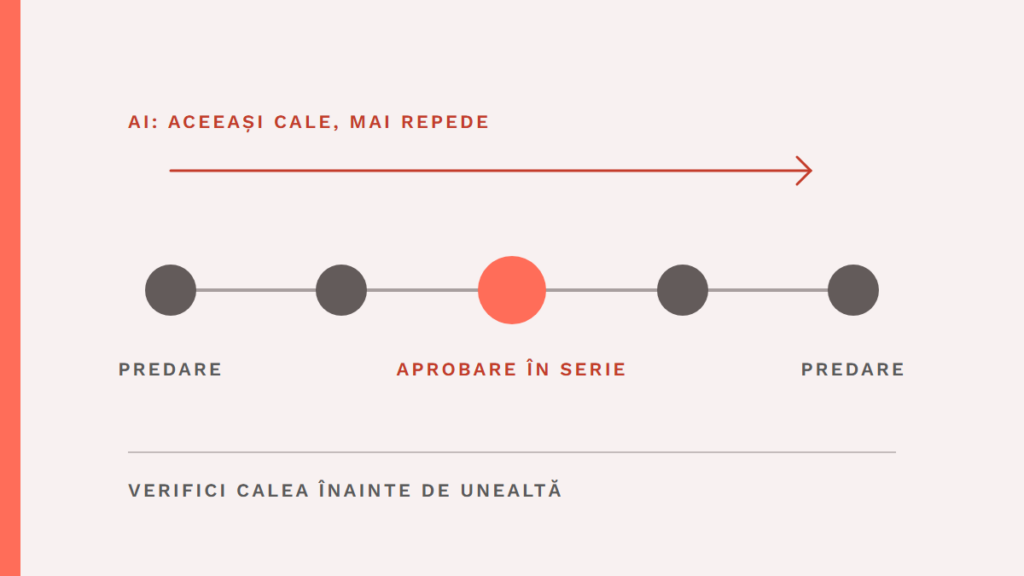
Do you have documents that three people read one after another, although each could read on the same day? Hassan found exactly that: several people checked the same brief in sequence. Move the approval to run in parallel, with a short deadline for each person.
Note on paper who changed what in the document. If nobody changed anything, the approval can run in parallel with no loss.
4. Look for double briefs
If the people who make the message and the people who run it work from different documents, each optimises for something else. One brief, written by one person, with one business result on the first line, points everyone in the same direction and removes a whole round of explanations between people working on the same request. Gary Vaynerchuk, of VaynerMedia, says in the report that media, creative and production should sit under the same roof.
5. Decide who answers for the result
Media is always at the scene of the crime. That is an internal saying of the report’s authors, quoted in it. The report adds that, according to the attribution studies it cites, the quality of the creative weighs most in return on investment.
For a small company, pick one person who answers for the result of the whole path, from request to delivery. Without that person, you fix the place where the problem shows. The cause stays untouched.
4. Only then the tool and the budget
When the path is clean, you choose the tool and put it at the step where you lose the most time. If you lose two days writing quotes, start there.
Then split the budget with care. Rishad Tobaccowala, an author cited in the report, gives a planning rule: for every dollar spent on technology and AI licences, two dollars go on training, reskilling and changing the way of working. The rule is his, and the report does not back it with a study.
As a starting point: if the budget for tools is bigger than the one for people, ask yourself who will use them.
What to take away
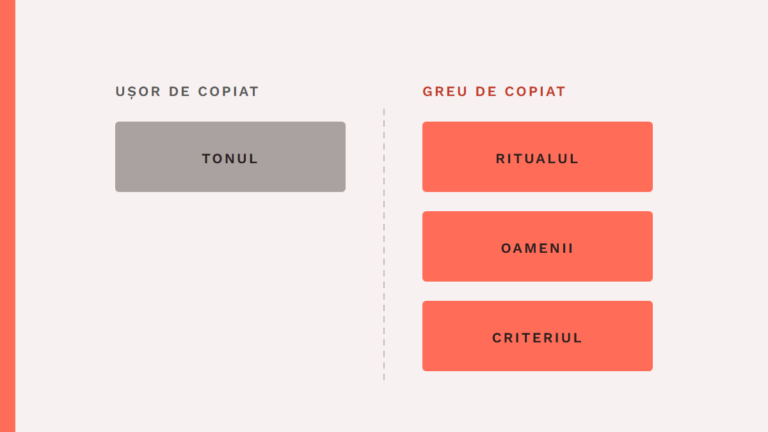
A bad process stays bad. Check the handoffs, the approvals in series and the double briefs before the subscription, so the tool enters a clean path, with one person answering for the result from request to delivery. The advantage that is hard to copy lies in the way your work is organised.
Brand Mentors
I work with companies through Brand Mentors
There I do brand strategy and consulting, starting from consumer psychology. You will find the services on brandmentors.ro.
Go to Brand Mentors