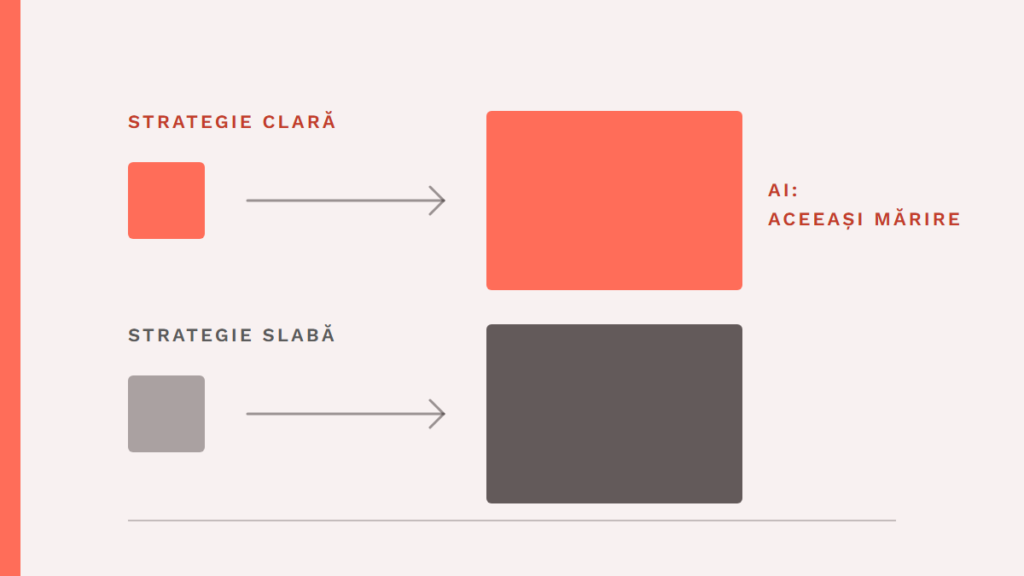
When strategy is missing, AI amplifies the gap. You get more texts, more campaigns and more mistakes, all in one week instead of one month.
The idea appears in “Lessons from the Frontier”, a report from the Frontier CMO podcast, hosted by Joshua Spanier of Google, gathered into seven lessons for chief marketing officers. The third lesson is called “Strategy before speed”. I read it with one reservation: the report comes from a company that sells AI and YouTube. The figures it gives are declared by companies, with no public methodology. I could check the most important one elsewhere. I return to it below.
1. What lesson three says
The report starts from a simple claim. A team with a clear strategy gets great speed from AI. A team with a confused strategy gets, in the report’s words, confusion produced at the speed of light. The report says that at most firms the bottleneck was the lack of a clear strategy. Execution speed always came second.
In short, AI works as an amplifier. An amplifier does not choose what is heard. If you give it a weak signal, it returns the signal louder.
For an entrepreneur, this changes the order of the questions. The question “which AI tool should we use?” comes after “what do we want to say, and to whom?”.
2. Ritson’s test
The report quotes Mark Ritson, founder of MiniMBA, a marketing training programme. Together with Ipsos, Ritson ran a test of basic knowledge for marketers. The report says almost 70% failed, and it credits Ritson with the joke that 90% of marketers have never had a strategic day in their lives. I know the joke only from the report.
I looked for the test at its source. Ritson described it in Adweek on 25 March 2026: ten questions below university course level, with four answer options, given to a representative sample of American marketers. Two thirds would fail, he writes. Over 40% do not know what positioning means, that is, the place a brand holds in the customer’s mind. And 84% consider themselves above average.
Ipsos then published the “Marketing Anchors” report, covering 1,226 marketers in the United Kingdom, the United States, Canada and Australia. The pass mark was seven correct answers out of ten. Only 35% reached it.
So the “almost 70%” in the Google report is a rounding of a broader result: 65% failed, across four countries, on a test given in the first part of 2026. The difference does not change the message.
One thing is worth saying. Ritson sells marketing training. The study’s conclusion, that formal training is the best predictor of the score, suits him. The data belong to Ipsos, and the methodology is public. The data are serious. The person presenting them gains from them.
3. What the test does not say
The test measures whether you know what segmentation, penetration or positioning is. It does not measure whether you have a good strategy. A person can pass the test and still work without a plan. Another can fail the definitions and be very clear about what they do.
The test does not prove that “marketers do not know strategy”. It remains a sign. If only a third of professionals master the basic vocabulary, many firms probably have a plan vaguer than their management thinks.
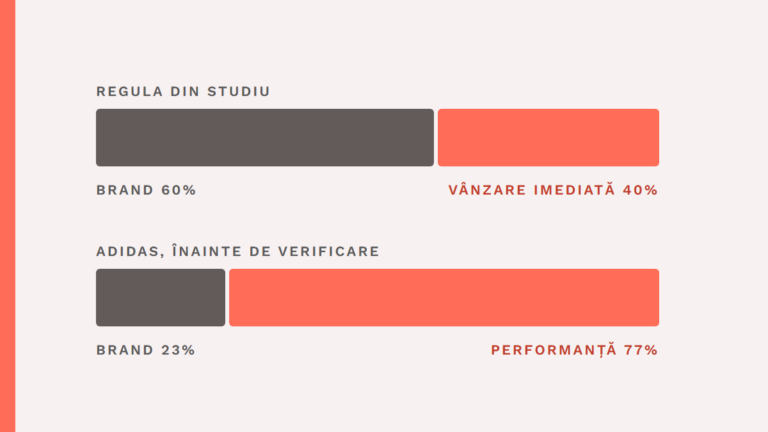
A vague plan also leaves the budget without a criterion for choosing. I wrote about how to split money between brand and today’s sales in the article on how much of your budget goes to brand.
4. What you write on the page you give the model
The report proposes an exercise. If the firm can squeeze its strategy onto a single page, that page becomes the input for AI. It asks the four basic questions: whom do we want to reach, whom do we explicitly not want to reach, what is our position against competitors, and what are the three goals for the next twelve months.
The second question is the hardest. “Whom we do not want to reach” is hard to write, because every lost customer hurts. But a language model cannot guess your refusal. If the page says “customers of all ages, with any budget”, the AI writes for everyone, which means for no one.
The third question asks for a position. “Good quality at a fair price” describes half the market and tells the model nothing about what not to write. A useful position gives it a limit: what you say, what you do not say, and against whom.
The fourth works as a filter. Three goals for one year mean that any request to AI can be checked in two seconds: it helps with one of them, or it does not.
5. The order that matters
The report uses the image of the Iron Man suit: the suit gives you speed, but a human strategist decides where you fly. Through a sentence from Ritson, it also says that AI is the fastest racehorse ever seen, and that someone who has never ridden does badly on it.
The title of the lesson speaks about a map. The map is drawn before the journey. A brand gets clarified before any campaign.
This sentence has nothing new in it. AI only gives it a more visible cost: a campaign without clarity used to take three months. Now it takes three days, and the mistake reaches customers faster.
One small exercise, at the end. Take the strategy page, if you have one, and give it to a colleague who knows nothing about the firm. Ask them to say whom the firm does not target. If they cannot, the model will not be able to either.
What to remember
AI amplifies what it receives, so strategy comes first. The Ipsos test given by Ritson shows that the basic vocabulary is missing more often than we like to believe: 65% failed, across four countries. If a page with four answers does not fit on one sheet, the problem is not AI.
Brand Mentors
I work with companies through Brand Mentors
There I do brand strategy and consulting, starting from consumer psychology. You will find the services on brandmentors.ro.
Go to Brand Mentors