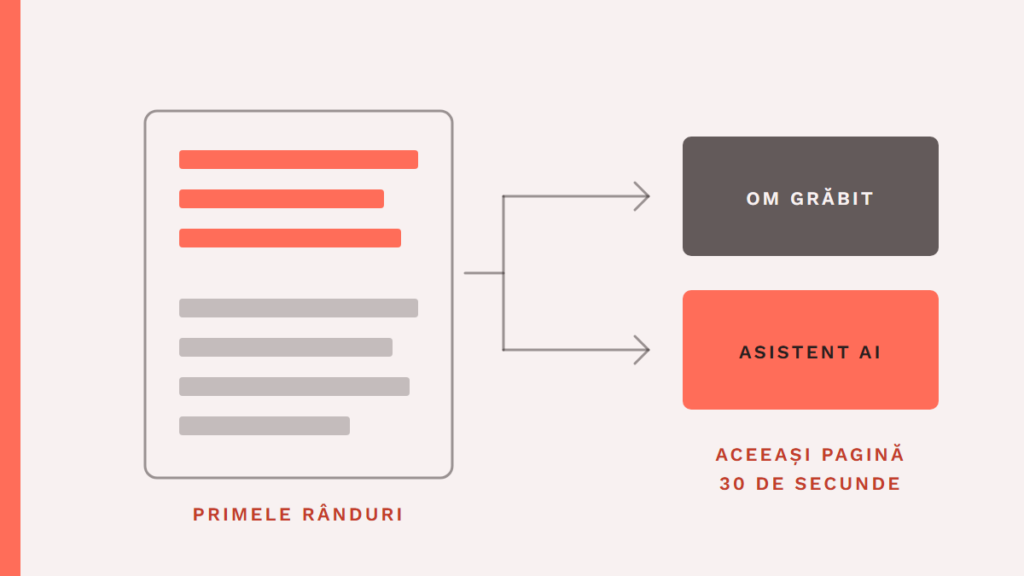
From the first lines of your site, an AI assistant learns what you sell, to whom, and why to choose you, if you wrote these things in plain words. If you didn’t, it learns what the hurried person learns: nothing useful. The check takes an hour.
You do it yourself, on five pages of the site, with no developer and no analytics tools.
The idea comes from a Google report, “Frontier CMO”, written from a podcast with marketing executives. The third lesson cites a conversation with Anda Gansca, chief executive at Knotch, a company that sells tools for site content. Google sells AI and YouTube, Knotch sells a tool for exactly the problem described, and the figures below are their claims, with no public methodology.
1. What the report says
Gansca says a company’s site now does two jobs. First: this is where people go to convince themselves before a purchase. Second: this is where AI models learn what your brand stands for, since the site is their source of truth.
On the official page of the episode, Google writes that “corrosive” content pushes 80% of traffic to leave at once. The report gives the same figure: about 80% of visitors leave in the first moment. It also says that, across hundreds of large brands analysed by Knotch, about 60% of the content is corrosive, meaning hyperoptimised for search engines, with high traffic, and made to trick the person into clicking.
The 80% figure also appears on the Knotch site, but there it speaks about visitors who came from an AI assistant. The 60% figure does not appear in any other public source I found.
The idea remains. You can check it without any report.
2. The 30-second party test
The report proposes an image. You invite people to a party at home and 80% leave within 30 seconds. You ask yourself what is wrong with the house before you print more invitations.
A person who lands on a site may have come from an AI assistant, where they typed the question in their own words. They expect a direct answer. The report gives the example of a person who wants an electric car “that doesn’t look like a family minivan”, with the answer in three seconds.
The image gives a rule. A person who doesn’t know you must learn from the first lines what you do and for whom, and the same test can be run with an AI assistant.
3. How to run the test
3.1. Pick five pages
Take the home page and the service pages, the landing pages (landing page) you send to clients most often and the ones any person who arrives by referral sees. The report asks for an audit of twenty pages. For a small company, five is a start.
3.2. Read only the start
Cover everything below the first screen. Keep the title and the first two or three sentences, exactly what the person sees before deciding whether to read on. Nothing more.
3.3. Ask four questions
Answer on paper, without looking at the rest of the page, using only what you read in the first lines. That is what a person would do who landed there by chance and has ten free minutes.
1. What does the company do, in one sentence that a person outside the field understands? 2. Who does it work for? Name one type of client, not “all companies”. 3. What problem does it solve, said the way the client says it? 4. What must the person do now, to go further?
If you answer “it doesn’t say” to any question, the page loses people. Fix that one first.
3.4. Give the text to a person and an assistant
Show only the first lines to a friend from outside the field and ask them to tell you what the company does. Then paste the same lines into an AI assistant and ask it the same question. The gap between the answers and what you meant to say is your list of corrections.
4. What to put on the home page
The first sentence says what you do, for whom and in what situation. “We design interiors for families renovating their apartment” is understood. “We create human-centred spatial experiences” says nothing about what the person gets, about the price or about how long it takes, so the reader is left with the same question they came with.
The second sentence brings a fact that can be checked, for example the year the company was founded or the number of projects delivered.
After them comes one next step. One button. The person who already understood what you do wants to know what comes next, and five buttons ask them to choose again.
5. What to put on the service pages
Each service page answers a client’s question. The history of the company stays for the about page, where whoever wants it looks for it once they understand what they get from you. The title takes up their question, the way they write it in a message, and the first sentence under the title answers it directly.
Then come three things, in this order: who the service is for, what the person gets in concrete words (what you deliver, in how long, at what price or from what price) and what happens after they contact you. Briefly.
A page written to attract clicks repeats the keyword in every paragraph and delays the answer. The person who reads such a page gets exactly the content the report calls corrosive.
6. How to write so you are recognised
The report says the antidote is to write for the real person, in an authentic voice. In the language of the trade, this is about positioning, meaning the place a brand holds in the client’s mind. A company that knows who it works for and what it promises writes naturally, because it has nothing to hide behind big words.
Read the text aloud. If a sentence would fit well on the site of any company in your field, rewrite it, because the same sentence from ten companies sets none of them apart.
7. Check before you believe
A marketing belief becomes a fact only after you have tried to contradict it.
The 80% figure comes with no public methodology. For your own site you can find out yourself: in Google Analytics you see how many visitors leave without doing anything on your service pages, page by page, in a single working day. If the rate is low, the test can wait, and if it is high, you have a page to rewrite.
The method of putting your own claims to the test is the same as in the article on marketing spend, where it applies to money. Here it applies to a page.
What to take away
The start matters. The hurried person and the AI assistant get the same clear answer from the first lines of the page, if you wrote in plain words what you do, who you work for and what comes next. The test takes an hour, with four questions, on five pages.
Brand Mentors
I work with companies through Brand Mentors
There I do brand strategy and consulting, starting from consumer psychology. You will find the services on brandmentors.ro.
Go to Brand Mentors