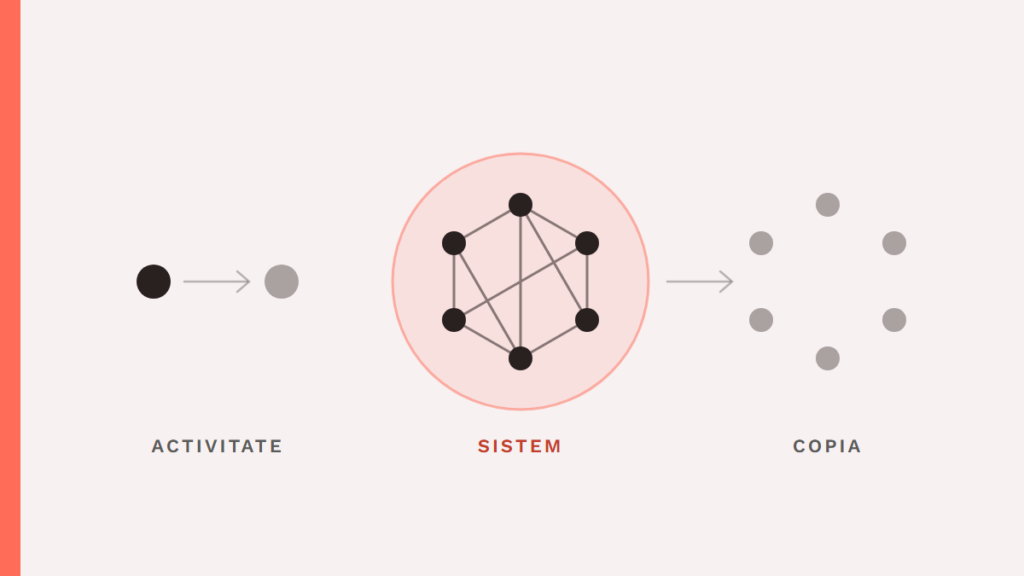
A competitor can see one of your activities, describe it and put it into practice at their own firm, but the links between your activities cannot be seen from outside. Those are the part they struggle to copy.
The idea has a name in strategy, fit between activities, and Michael Porter described it in 1996, in an article in Harvard Business Review. Its title is “What Is Strategy?”. Two of his examples are Southwest Airlines and IKEA.
What fit means
Porter uses the word fit, meaning the way a firm’s activities support one another. Activity here means anything concrete the firm does. It covers how it sells, how it delivers, what it offers and what it refuses to offer.
Porter writes that fit keeps imitators out, because it makes strategy a chain that is as strong as its strongest link. It is the proverb about the weakest link, turned upside down.
For an entrepreneur who watches what competitors do, I would sum up Porter’s idea in two sentences. A competitor can copy one of your activities easily. Copying the way your activities hold each other up is hard.
Southwest: four choices that hold each other up
In the 1996 article, Southwest planes spent only 15 minutes at the gate between two flights, and Porter writes that this let them fly more hours than their rivals’ planes and run frequent departures with fewer aircraft. On board you got no meal and no assigned seat. The whole fleet was made up of the same model, the Boeing 737.
Taken separately, each choice can be copied, and Porter admits it directly: any airline can buy the same planes. What is hard to copy is the whole. The 15-minute turnaround holds only as long as the other activities let it hold.
Think what would follow if Southwest added meals on board and assigned seats, like a full-service airline. Preparing the plane between flights would gain extra steps. And every extra step hits exactly the activity that keeps the planes in the air for more hours.
Why the whole is hard to copy
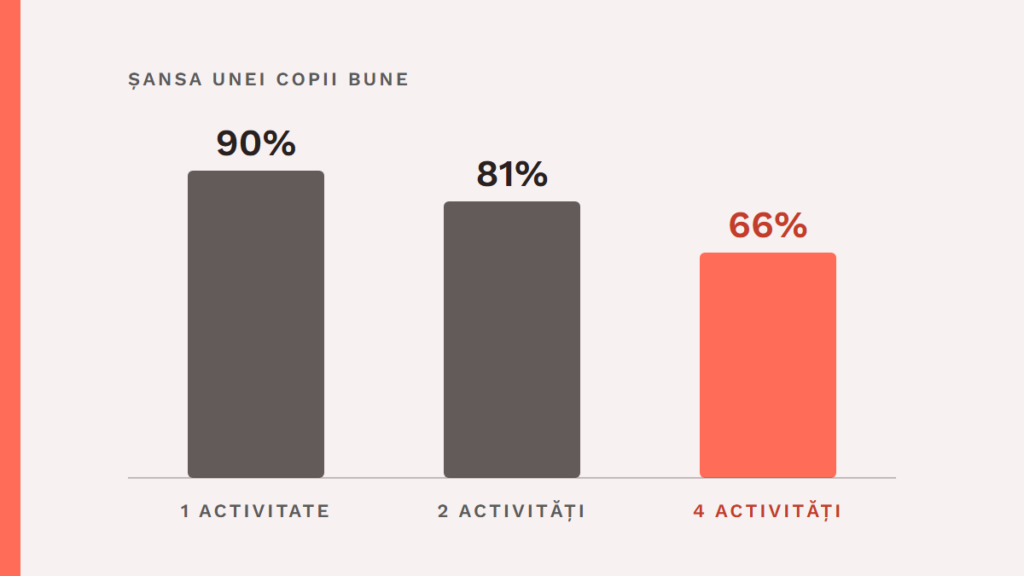
Porter also does a simple calculation, which I repeat with his figures: a competitor has, say, a 90% chance of copying one activity well. With two activities, the chance drops to 81%. With four linked activities, it falls to 66%, because the probabilities multiply.
His conclusion is that a position built on a system of activities lasts much longer than one built on activities taken separately. The calculation also shows something less obvious. Each activity linked to the others forces the competitor to copy one more piece, then one more link.
IKEA: the customer does part of the work
In Porter’s description, IKEA targeted young people buying furniture who want style at a low cost. The firm had shaped its activities for these customers.
In the store, no salesperson followed you around, because IKEA used self-service, with products clearly displayed in furnished rooms. The furniture was designed by IKEA, modular and ready to assemble. Next to the showroom stood a warehouse with the products in boxes, on pallets, where the customer picked up the furniture and took it home.
This is where fit shows: flat-pack furniture fits in boxes, the boxes sit in the warehouse next to the showroom, and transport and assembly pass to the customer. Each choice makes the next one possible.
Porter notes one more thing that matters for competitors. The more tightly IKEA linked its activities to cut costs, letting the customer assemble and transport the furniture, the harder it is for IKEA to serve people who want more service. A full-service furniture store would have to give up part of its customers to copy the system.
What competitors copied from Toyota
In 1999, Steven Spear and H. Kent Bowen published the article “Decoding the DNA of the Toyota Production System” in Harvard Business Review. Their study lasted four years. They researched over 40 plants in the United States, Europe and Japan, some that worked by the Toyota system and some that did not.
The authors write that the system’s visible practices were taken up widely by other firms. Among them are quality circles and kanban cards, meaning a laminated card through which a worker requests parts, with the part code, the quantity and the place they come from. GM, Ford and Chrysler each started a large programme to build a production system on the Toyota model.
Most imitators fail, the article’s abstract says. Spear and Bowen also give the explanation: the people who visit the plants confuse the tools and practices they see with the system itself.
Under the tools sit four unwritten rules, which the authors call the DNA of the system. The first requires that all work be specified in detail: its content, the order of steps, the timing and the outcome. The managers who adopted the obvious practices left aside exactly these rules.
Toyota shows the same idea as Porter, seen from inside the plant. A kanban card taken without the rules that tie it to the rest of the work remains an isolated activity. It is copied easily, like any activity taken separately.
An exercise for your firm
Take a sheet of paper and write on it five or six activities that your firm does differently from competitors. Think about how you sell, how you deliver, what you refuse to offer and how you set the price. Write each activity concretely, the way a customer would describe it.
Then take the activities two at a time and ask yourself whether one makes the other cheaper, faster or easier for the customer to believe. When the answer is yes, draw a line between them.
At the end, count each activity’s lines and look first at the ones with zero. An activity with no lines is the one a competitor copies most easily, because they can take it on its own, without changing anything else in their firm. The activities with the most lines are the ones the rest depends on.
Also look for activities that get in each other’s way, for example a promise of fast delivery next to production made only to order. A pair like that drains money from both sides. Then ask yourself the question Porter raised at IKEA: which customers do you turn away by the way you work?
If the answer is “none”, your activities are probably trying to please everyone. In that case they link up poorly, and each can be copied in turn.
What to remember
One activity taken separately is easy to copy, because it can be seen and put into practice without the rest. The hard-to-copy advantage sits in the links between activities, which Porter calls fit. Write your activities on a sheet of paper and see how many of them hold each other up.
Brand Mentors
I work with companies through Brand Mentors
There I do brand strategy and consulting, starting from consumer psychology. You will find the services on brandmentors.ro.
Go to Brand Mentors