Clarify your brand before you pay for channels, because a channel carries only the message you hand it. Without a clear positioning, meaning the place you want to hold in the customer’s mind, that message does not fit in one sentence. The channel charges you the same either way.
Many founders ask the questions in reverse order: first “which channel do I enter?”, and only then “what do I say there, and to whom?”. I work from one simple rule: “A brand gets clarified before any campaign.”
1. Three phases, in a fixed order
Mark Ritson described this order in an excerpt from his book Eat Your Greens, published by Mumbrella on 2 November 2018. The excerpt opens with a short line: “There are three phases to all marketing work.”
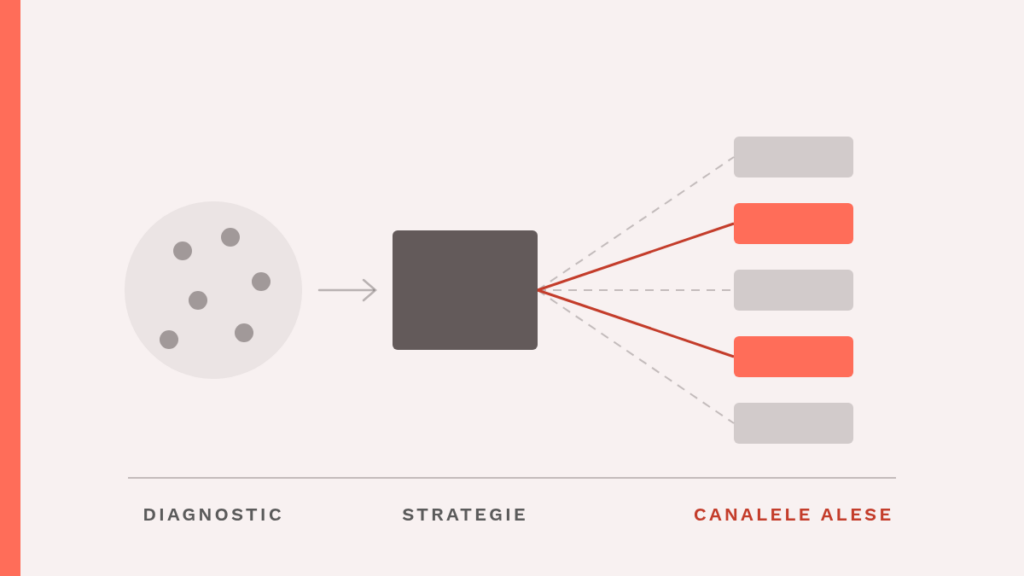
The first phase is diagnosis. You use research with consumers to find out what is really happening to your brand. From the diagnosis you build a strategy, clear and simple. Only with the strategy written down do you pick the tactics that carry it out, from channels to price.
The order matters because each phase works with what the previous one left behind. Skip the diagnosis and your strategy is a well-formatted guess. Skip the strategy and you choose tactics by whichever supplier pitches best.
2. The word Ritson invented
In the same excerpt, Ritson names the problem tactification: an obsession with the tactical side of marketing at the expense of the deeper work that should come first. He apologises for the clumsy word and admits: “I made up this word.”
Inside a company, tactification looks mundane. Someone proposes a new social account, someone else a paid search campaign, and the meeting ends with the budget split between channels. Nobody has yet written down on one page who the company sells to and why a customer would choose it.
That meeting feels productive, and that is the hard part. Everyone leaves the room with a concrete task, and next to those tasks the diagnosis looks like a delay the company cannot afford.
3. Where the money goes when you start with the channel
The loss does not show up on a single line of the books, so you rarely spot it in the monthly figures. You find it in four places.
Redone materials. You launch with one message on the website and another in the ads, and a few months later you realise neither says why a customer would pick you. You redo the copy, the photos and sometimes the names of your offers, so you pay twice for the same work.
Numbers you cannot read. A campaign launched without a hypothesis brings you clicks, impressions and a cost per customer. With no strategy you have nothing to compare the numbers against, so you do not know what to change in the next campaign.
Suppliers who choose for you. Every agency or freelancer proposes what they know how to do, and that is natural. Without a written strategy you compare offers by their presentation and buy the supplier’s skill instead of the path your brand needs.
Messages that do not add up. The customer sees you on three channels with three different promises and does not connect them to one company. At every encounter you start from zero and pay again for a first impression.
I keep one short line for all four: “A campaign without a clear brand is just paid noise.”
4. Diagnosis comes first, and the calendar squeezes it
In an article published on minimba.com on 21 January 2021, Ritson puts diagnosis at the start of every brand strategy: “The first step in any decent brand strategy is a step back.”
Ritson compares this step to the generals of ancient Greece, who surveyed the terrain before a battle. For a small company, the step back means conversations with customers who bought recently, a look at last year’s sales and a list of the reasons some customers left. None of this needs the research budget of a large firm.
In the end, the diagnosis leaves you a few sentences you can check: who buys, which alternative they would have chosen, and what convinced them to stay with you. You build the strategy on them, and in the strategy you also choose whom you stop talking to.
Ritson then looks at the calendar. Execution starts with the financial year, so you plan backwards from that date and leave room for diagnosis, approvals and tactics. On the gap between research and execution he writes: “Often the lag can be six months.”
The arithmetic is simple for a founder who wants a campaign in March. If you only start asking customers in February, the campaign either goes out without a diagnosis or goes out late.
5. How to pick a channel once you have a strategy
On the third axiom in the same article, Ritson is even firmer. The four Ps of marketing, product, price, placement and promotion, are tactical levers to him, and his advice is short: “Don’t touch them until your strategy is complete.”
In that text, strategy answers three questions: whom you target, what you want to stand for with that customer, and how you get there. Once you have the answers, Ritson says, tactical decisions get easier. Choosing a channel comes down to one check: does the channel reach the people you chose, and can it carry the message you chose?
Sometimes the check shows that a fashionable channel does not reach your customers. Then the strategy gives you the reason to turn down a good proposal, and you can explain the refusal to your team in one sentence.
You can run a test tomorrow. Write on a single page whom you sell to, what you want the customer to believe about you, and which number tells you that you succeeded. If one of the three lines stays empty, hold off on signing the contract for the next channel.
What to remember
Diagnosis comes first, strategy second, channels last. When you start with the channel, you pay twice: once for the ad and again for the materials you redo after you learn whom you sell to. Before a new channel, write on one page whom you sell to, what you want to stand for and how you will measure it.
Brand Mentors
I work with companies through Brand Mentors
There I do brand strategy and consulting, starting from consumer psychology. You will find the services on brandmentors.ro.
Go to Brand Mentors