When nobody asks, customers stay where they want, react to what touches them and choose without explaining the choice to anyone. These gestures show you where to look for an insight (a discovery about the customer that explains a behaviour). What people say about themselves comes second.
I have written before about the road from observation to insight and about what your client won’t tell you about themselves. Now I look at a Romanian case where customer behaviour shows in the mechanism of the campaign itself, so you can see how to read it in your own category.
1. What a focus group gives you
A focus group (a group discussion with customers, led by a moderator) gives you what people believe about themselves, said aloud in front of strangers and a team listening from the next room. The material has a limit. At the table, people pick the answer they can defend in front of the others.
That is how you learn how customers would like to look. It is harder to learn what they did last week, in the shop, on the phone or at home, with their own money and time.
Behaviour has other sources. You find it in receipts, in order histories, in the hour when people call your company, and in places where they spend hours without a thought for your category. There, nobody plays a role for you.
My position on this stays the same: “An hour with five real customers says more than a day of brainstorming in a meeting.” Brainstorming (a meeting where the team throws out ideas) collects opinions about customers. The hour with customers brings you concrete events.
2. The Old Spice case
The campaign “Unexpected Heroes”, created by Leo Burnett Bucharest for Old Spice, with Procter & Gamble as the client, won the Grand Effie at the Effie Awards Romania in 2025. The jury chose it unanimously. The shortlist had six cases with gold.
The mechanism appears in the announcement of the Effie Europe 2025 winners, published by EACA. The team created in-game names for professional players, inspired by the names of Old Spice fragrances. Under these names, the players challenged others during live streams, without revealing their identity at first.
At Effie Europe, the campaign won two Silver awards, in the categories “Influencer Marketing” and “Marketing Strategy & Idea”. In the WARC Effective 100 ranking for 2026, “Unexpected Heroes” sits at number 79. I could not verify the sales figures in the award entry, so I do not use them.
3. Which gestures show in the mechanism
The sources I read describe what the campaign did. They do not describe the research behind it. I do not know how the team reached the idea, and I will not put in the agency’s mouth an insight it has not published.
Read as a series of observations, the mechanism rests on three things that players do without anyone asking them and without a thought for a deodorant. You can see them on any evening, in any stream.
They watch others play. A live stream is a place where people choose to stay, with their attention on the screen, for as long as they decide. A brand that enters there enters their habit.
They answer a challenge. A player challenged during a stream reacts in the game, under the eyes of the viewers. Through that gesture, the player enters the story.
They judge the opponent by how they play. The in-game names hid the identity of the professionals, so people first knew them by their style of play and learned their real names later.
None of these gestures needs a questionnaire. If you had asked the players in a focus group what they expect from a deodorant, you would probably have got answers about smell, price and how long it lasts. Those answers describe the product and say little about where the person’s attention sits.
4. Four steps for your category
You can take the steps below with your team, without a separate research budget.
Step one: write down where the customer is without you. Make a list of the places where the person you want to serve spends time, with no link to what you sell: groups, forums, shows, games, markets, waiting rooms. Pick two.
Step two: note gestures with verbs. Write what people do there: search, compare, complain, recommend, give up, come back. A sentence like “they care about quality” does not describe a gesture, and you cannot observe it in anyone.
Step three: look for repetition. A gesture seen in one person is an anecdote. The same gesture in people who do not know each other, in different places and on different days, is an observation you can work with.
Step four: take the observation into the interview. Ask about the last time the person made that gesture: where they were, what came next, what they tried before. The order has a reason.
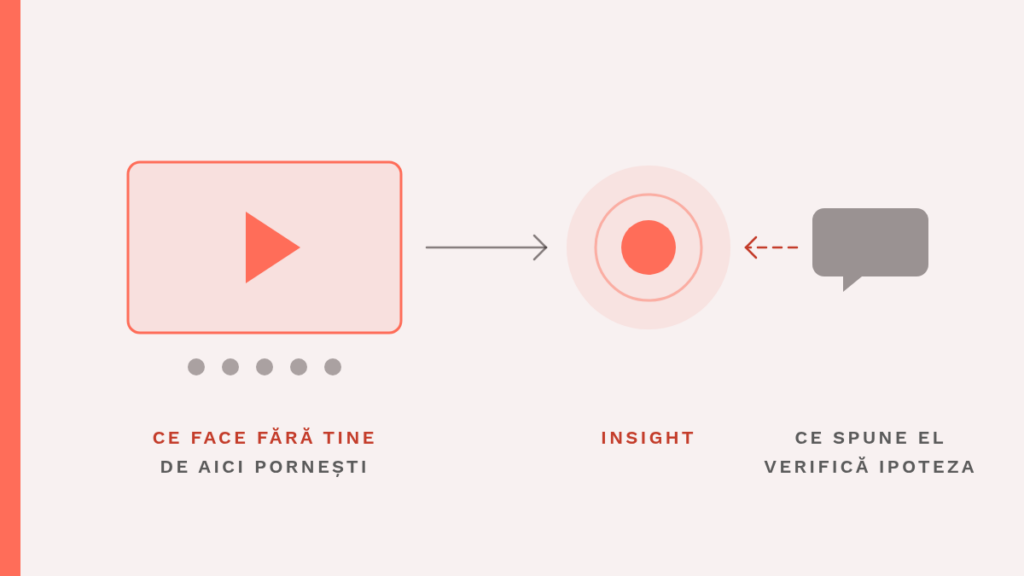
A good insight starts from what the customer does and is then checked against what the customer says.
5. Where behaviour can mislead you
Visible behaviour shows you mostly the people who leave traces. The customer who comments or complains appears in your notes. The one who buys in silence and leaves does not appear at all, though they may weigh more in sales.
Check who is missing. A gesture shows you what the person does. The reason stays a hypothesis until you hear it from them, asked about a concrete situation from their life, with details they cannot invent on the spot.
An award-winning case can also mislead you. You read it from materials published after the gala, written by the people who made the campaign to show what worked. Read it for the mechanism and doubt the figures.
What to remember
What the customer does without you shows where to look for an insight, long before you ask the first question in an interview or in a focus group with your customers. The interview checks it. In “Unexpected Heroes”, the players’ gestures are in plain sight, inside the mechanism of the campaign itself.
Brand Mentors
I work with companies through Brand Mentors
There I do brand strategy and consulting, starting from consumer psychology. You will find the services on brandmentors.ro.
Go to Brand Mentors