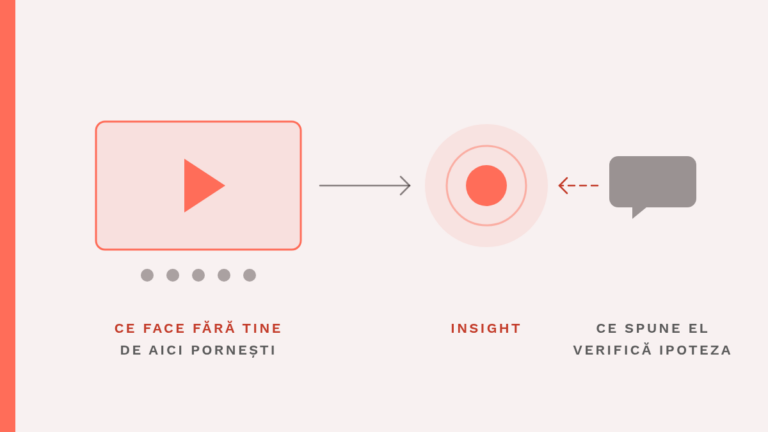
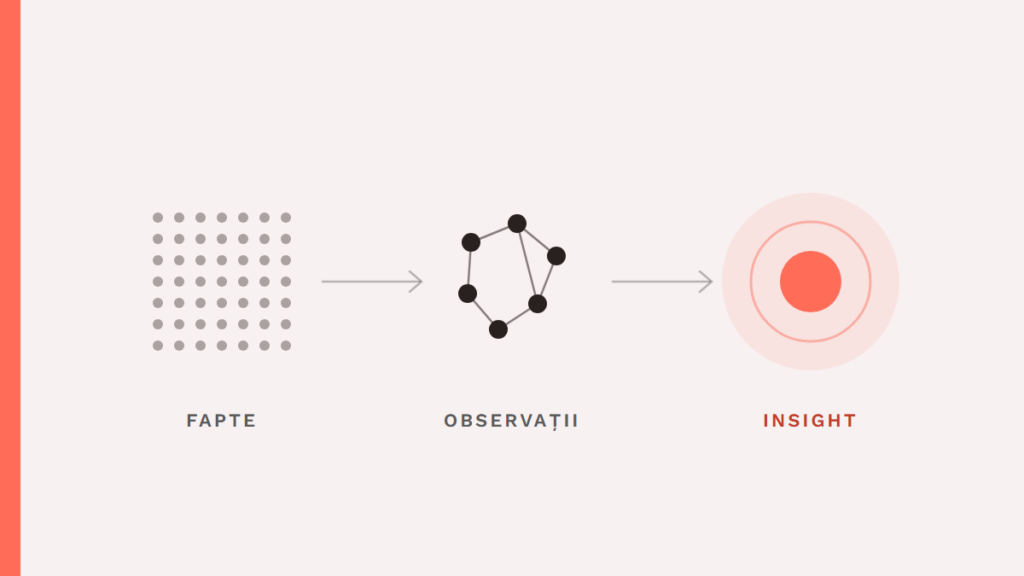
An observation describes what people do. An insight explains why they do it, with a reason they recognise as true even if they never said it out loud. An observation tells you where to look, and an insight tells you what to build.
In marketing briefs the word insight appears on almost every page. Here I use it with one meaning only: a discovery about the customer that explains a behaviour. Most “insights” in briefs are really figures or observations.
1. Observation vs insight: the difference in one minute
A figure tells you how much, an observation tells you what, and an insight tells you why. Only the last one gives you something to build on.
A fact is something you can count or check. For example, “snack bar sales rise in the afternoon” or “half of customers abandon the basket before paying”. A fact is the starting point, but it explains nothing.
An observation is what you see people do, in their own context. The customer looks at the price, puts the product back and takes a smaller one. The observation describes the behaviour without saying why it happens.
An insight ties the behaviour to a reason the person recognises, even if they would not have said it themselves. When you hear it, you feel you knew it already. That feeling is a good sign.
2. Observation to insight examples
Four examples follow. The first is a real campaign with a public source. The other three are illustrative: I invented them for this article, and they carry no real company and no data.
Snickers, 2010 (real campaign)
On 28 January 2010, Mars announced a new Snickers campaign by BBDO New York. It debuted in the first commercial break of Super Bowl XLIV, with a spot called “Game” starring Betty White and Abe Vigoda. The message of the campaign is “you’re not you when you’re hungry”.
Mars has not published its research, so the split below is my reading of the campaign, not its brief.
The fact is banal: people eat snack bars between meals. The observation goes further: hungry people turn irritable, slow or odd, and those around them notice first. The insight says why: hunger makes you stop being like yourself.
That insight gave the bar a clear role in the person’s life: it helps you be yourself again. Mars says the campaign has since featured dozens of celebrities and athletes around the world.
A bakery in a mid-sized Romanian town (illustrative)
Observation. Customers ask for a whole loaf, look at it, then buy two small rolls. Many of them live alone or as a couple.
Insight to test. People buy small because they hate throwing bread away, and a whole loaf feels like a promise they will not keep. It suggests a half loaf, sold cut, with the baking day on the bag.
A furniture shop selling online (illustrative)
Observation. Shoppers add a wardrobe to the cart, leave the page and come back the next day. Messages to the shop ask for the exact size of the packed box.
Insight to test. Buyers fear the piece will not fit up the stairs of a block of flats without a lift, and nobody wants to find out while the courier waits at the door. It suggests putting the packed dimensions next to the product photo.
An accounting firm for small businesses (illustrative)
Observation. Owners send their invoices on the last day of the month, in one batch, often as phone photos.
Insight to test. Owners postpone the paperwork because opening it means finding out what they did wrong. It suggests a first message each month that says what is already in order.
Each “insight to test” stays a hypothesis until customers confirm it. Steps 2 and 6 below show how.
3. Six steps from observation to insight
The road between an observation and an insight runs through people. These are the six steps I follow.
Step 1: Gather the facts and stop in time
Start with what you already have: sales, customer questions, searches on your site, reasons for abandoning a purchase. Write each fact on one line, with its source beside it. Facts show you where to look, and from there you move on to people.
Stop when the facts start repeating. A table with two hundred rows keeps you at your desk, away from the people who can explain the figures.
Step 2: Go to the customers
I say this without reservation: “An hour with five real customers tells you more than a day of brainstorming in a meeting.” Brainstorming, the meeting where the team throws out ideas, mostly produces opinions about customers. An interview shows you what people do, and I explain when it beats an agency briefing in When does field observation beat the agency briefing?.
Ask about the last time the person bought a product in your category. Ask them to tell it step by step: where it happened, at what time and who was there. A concrete memory teaches you more than a general opinion, and How to find out what your client won’t tell you about themselves goes deeper into the questions.
Step 3: Note what people do, separately from what they say
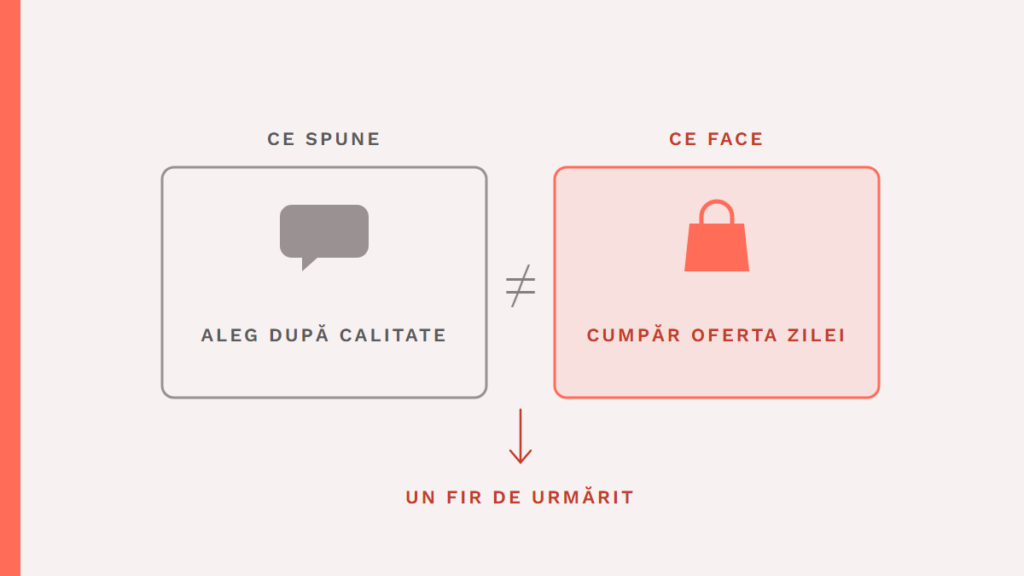
Keep two columns in your notes: in one, what the person says, in the other, what they actually did. Look above all for the differences between the two columns. A customer who says they choose on quality and always buys the offer of the day gives you a thread to follow.
A sentence from the customer, written down exactly as they said it, helps you later to check whether the insight sounds like them or like the marketing team. More on this in What do customers do when nobody asks them?.
Step 4: Look for the tension
An insight usually starts from a tension: the person wants one thing, and something stops them or pushes them elsewhere. In my reading of Snickers, the tension is between who you want to be in front of others and who you become when you are hungry. For each observation, ask yourself what the person wants and what gets in their way.
Habits hide tensions too. How to find the tension behind a habit shows how to spot one.
Step 5: Write the insight in one sentence
Use a simple form: “People [do something] because [the reason they recognise].” If you need three sentences to explain it, you have not found it yet. Write several versions and keep the one that anyone on the team understands.
For Snickers, the form would go roughly like this: “Hungry people behave differently from usual, because hunger takes hold of them.” The sentence is short and easy to check.
Step 6: Test it with three questions
First question: does the insight explain a behaviour you have seen with your own eyes? Second: do customers recognise it when you read them the sentence? Third: does it suggest something to do, for the product or for communication?
An insight that passes the first two questions and fails the third is interesting, but it is not useful to you yet. Set it aside and keep looking in your notes.
4. What is not an insight
A figure, however surprising, stays a fact until you find out why it appears. How to tell an insight from a beautiful statistic covers this trap in detail. A generic desire, like “people want quality products at good prices”, holds in almost any category and tells you too little to build on.
A description of the product is not an insight either, even if it talks about the customer. “Customers appreciate fast delivery” describes a feature. An insight would explain why a one-day delay in delivery makes the customer order from someone else.
A team hypothesis becomes an insight only after customers confirm it. Until then, written as a question, it is a good starting point for interviews.
5. Observation vs insight: common questions
What is the difference between an observation and an insight?
An observation records what people do. An insight explains why they do it, with a reason they recognise. The observation points you to the right place, and the insight gives you something to build.
What is an example of an insight vs an observation?
Observation: shoppers add a wardrobe to the cart and leave the page. Insight: they fear it will not fit up the stairs of their block of flats. Section 2 has this example and three more, one of them a real campaign.
How do you turn an observation into an insight?
Ask what the person wants and what gets in their way. Write the answer as “People do X because Y” and read it to customers. If they recognise it, you have an insight to test.
Is a statistic an insight?
No. A statistic tells you how much, so it is a fact. It becomes part of an insight only when you can explain the behaviour behind it.
6. What to remember
Facts tell you where to look, observations show you what people do, and the insight explains why. The road between them runs through conversations with real customers. A good insight fits in one sentence that the customer recognises.
Brand Mentors
I work with companies through Brand Mentors
There I do brand strategy and consulting, starting from consumer psychology. You will find the services on brandmentors.ro.
Go to Brand Mentors