A brand grows mostly through penetration, the number of category buyers who buy your brand at least once in a period. Loyalty rises after it, in small steps. Byron Sharp gathered the evidence in How Brands Grow, a book published by Oxford University Press in 2010, based on research that the Ehrenberg-Bass Institute has done for several decades.
Many marketing plans start from the other end. We have customers, we make them more loyal, they will buy more often and the brand will grow. It seems logical.
1. The law of double jeopardy
The social scientist William McPhee gave the phenomenon its name in 1963: double jeopardy. He first observed it among Hollywood actors, in scores for awareness and likeability. A little later, Andrew Ehrenberg showed that the same rule appears in the buying of brands.
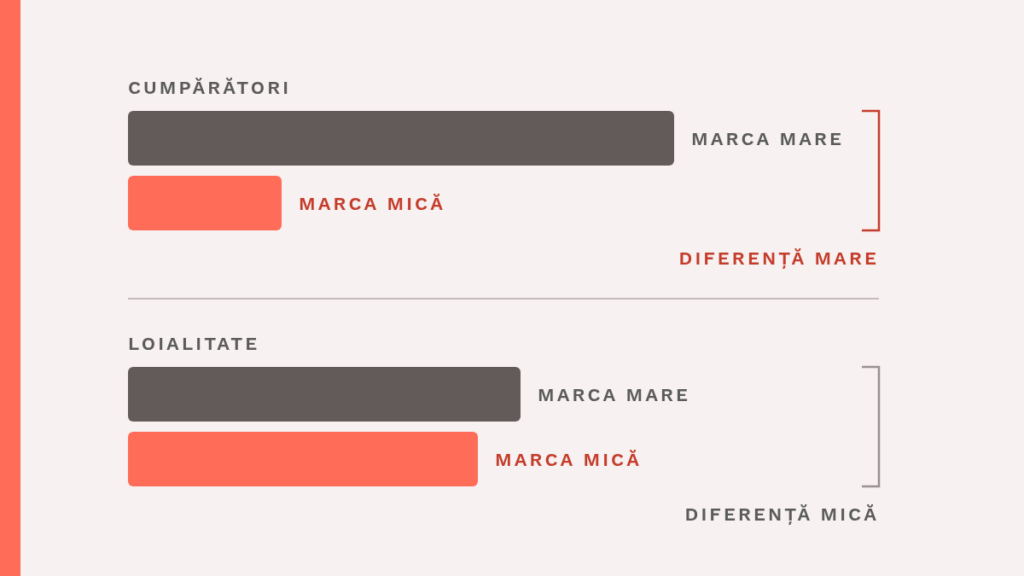
The law says that, within a category, brands with a small market share have, in a given period, far fewer buyers and somewhat lower loyalty than big brands, with very few exceptions. They lose twice. The loyalty gap between a small brand and a big one is small, while the gap in buyers is large.
For an entrepreneur, the consequence is simple to read. If you want your brand to get bigger, you first need more people who buy it, even rarely, even alongside other brands in the category.
2. What Sharp writes about loyalty
Sharp does not say that loyalty is absent. In How Brands Grow he writes that brand loyalty is part of every market. On the institute’s site, in a text where he answers critics, he puts it more briefly: all brands have loyalty, and big ones have a little more.
The same text links the two measures. Loyalty indicators and penetration indicators are tightly linked, Sharp writes, and for an ordinary brand even a modest sales or share target requires doubling or tripling penetration per quarter. For an entrepreneur planning next year, this ratio changes the discussion in the budget meeting.
There is one more detail. Sharp reminds critics of the word “double” in the name of the law, which shows that part of the growth also comes from existing customers, who buy a little more often as the brand gets bigger. The stress falls on “a little more often”, a phrase to remember when you read a loyalty plan that promises customers who buy twice as often.
3. Where intuition breaks
The idea that keeping a customer is cheaper than winning a new one circulates in marketing presentations, in courses and in the budgets of firms that want to grow without spending much on advertising. It sounds prudent. The problem appears when the team concludes from it that a loyalty programme will grow the brand, without looking at how many buyers it has compared with competitors.
This is where critical thinking comes in. A marketing belief becomes fact only after you have tried to contradict it. The law of double jeopardy gives you a good test for the belief about loyalty, because it tells you in advance what result to expect.
Take two coffee brands from the same shelf. If the small brand has customers as loyal as the big brand, you have found a rare exception and it is worth studying. The law tells you that you will more often find a different picture: the small brand has fewer buyers, who buy it a little less often than the buyers of the big brand buy their favourite product from the shelf.
Ask your team a simple question before launching a loyalty programme: if the programme works, by how much do the number of buyers and the frequency grow? Write both figures on paper and compare them with the real ones after six months. The difference shows you how well you guessed.
4. How to check in your own figures
Start from last year’s sales and split them into two numbers: how many different buyers you had and how many times, on average, each of them bought. Do the same calculation for the year before. That shows you where the growth or the decline came from.
If you sell online or have customer cards, you already have the numbers in your system. If you sell through distributors, ask them at least for the number of unique customers per month and how much each ordered, because without them you only see the total invoiced and you do not know who bought.
If sales went up, the law makes you expect more buyers and only a slightly higher frequency. Frequency moves little from year to year. If frequency grew a lot at your company and the number of buyers stood still, check whether a single large customer has not changed the average.
Then put competitors’ data next to your figures, from a consumer panel or from whatever you can learn from the market. A small brand with a frequency close to the leader’s and several times fewer buyers has a buyer problem. A loyalty programme does little for that problem.
Before you move budget towards loyalty, test the programme the way you would test any spend, with one group that receives it and one that does not. I wrote about how to check a spend in the article on how to tell if a marketing spend brings anything. I wrote about splitting the budget between brand and today’s sales in How much budget for brand.
5. What this rule says
Look after your existing customers. They keep buying, and they need to find the brand in its place, with the same quality and the same price they know, every time they walk into the shop. The law only tells you what to expect from them.
Exceptions exist. The Wikipedia article on double jeopardy gives the example of Hispanic television channels, with few viewers who watch an unusual amount. So the exception has a small, highly involved audience, which few brands have.
If your brand looks like an exception, first check that you have data over a long enough period and from enough buyers, because one good year or one large order can make a small brand look very loyal. Only after that check do you build on the exception. Otherwise you build on a lucky year.
What to remember
A big brand has many buyers and only slightly more loyalty than a small one. Before you put money into loyalty, count how many people buy your brand and compare yourself with competitors. Growth comes first from new buyers.
Brand Mentors
I work with companies through Brand Mentors
There I do brand strategy and consulting, starting from consumer psychology. You will find the services on brandmentors.ro.
Go to Brand Mentors