You usually make two mistakes, in this order. First you look for competitors only among firms that make the same product you do, and you miss the alternative from another category, the one that takes your customers without ever appearing in a market analysis. Then, once you find out about it, you swing to the other extreme and draw a market your firm cannot serve.
Each mistake has an author who described it. The first comes from Theodore Levitt, a marketing professor at Harvard Business School and a former editor of the Harvard Business Review. The second comes from Henry Mintzberg, who answered Levitt much later.
1. What Levitt wrote about growth
The article is called “Marketing Myopia” and it appeared in the Harvard Business Review, in the July-August 1960 issue. Its first sentence reads: “Every major industry was once a growth industry.”
Levitt then asks why an industry stops growing, and from the first paragraph he rejects the easy explanation, a saturated market. The cause, he writes, is “a failure of management”.
In his argument, management looks at the product the firm makes and loses sight of the person who buys it, with that person’s reasons and the other options available for getting the same thing. The idea fits in one line.
The hard part is applying it in your own firm, where sales reports, product sheets and the competitor list are all organised around what you make, and none of them shows you what else the customer weighed.
2. The railroads and the question they did not ask
The main example is the railroads. The summary published by HBR says the industry stopped growing because the people running it believed they were in the railroad business. Levitt’s conclusion: “They were railroad oriented instead of transportation oriented; they were product oriented instead of customer oriented.”
A person buying a train ticket wanted to reach another city, at a certain hour, with their luggage. The train was one of the ways to get there. A firm that looks only at the tracks sees its competition after the customer has already left.
My position is close to this: “Customers buy the progress they make with a product. The product is only the road.” Today a related idea has an established name, Jobs-to-be-Done (the progress a customer is looking for when they buy).
3. What the mistake looks like in a small firm
Take a workshop that makes custom kitchen furniture, in a town with four similar workshops. If it defines its market by product, it compares itself with them on price, lead time and the quality of the hardware. The table comes out clean.
The customer who walks in weighs something else entirely: a new kitchen this year, a bathroom renovation, a second-hand car, or one more year with the old kitchen and the money set aside. None of these options appears in the table of four workshops.
The workshop loses the customer to the bathroom and draws the wrong conclusion: that it asked too much compared with the neighbour on the same street. It cuts the price. It loses margin and still does not win the person who chose the bathroom.
The example is constructed, but you will find the mechanism in many firms that count their competitors by activity code. The list shows who does the same thing you do. The customer chooses among the things they can afford this month.
4. Where the broad definition breaks too
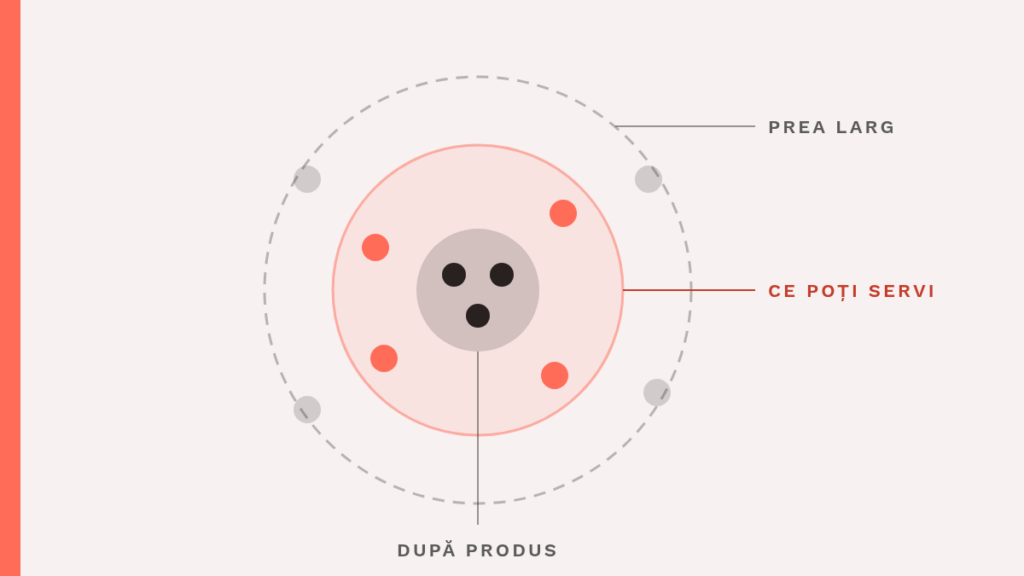
On 15 August 2018, on his own website, Henry Mintzberg published a text that turns Levitt’s title around: “‘Marketing Myopia’ Myopia”. He describes what many firms did after the article: they rewrote their business definition as broadly as possible, sometimes down to an empty formula.
One example from his text is a ball bearing firm that wrote its mission as “reducing friction”. Mintzberg blames exaggerated assumptions about what a firm can do with the people, technology and channels it has on the day it writes its mission.
His question is simple. “How can a few clever words on a piece of paper make a railroad fly airplanes?” His conclusion: “marketing myopia” often turned out to be myopic itself.
The two texts read well together. Levitt tells you to look at what the customer is after. Mintzberg reminds you that you can serve only the part of that search which your firm can support today, with the people and equipment it has.
5. How to test your market definition
A marketing belief becomes a fact only after you have tried to contradict it. Your market definition is a belief of this kind, written once in a business plan or a presentation and then used for years without passing any test.
Three questions help.
What else did the customer weigh before choosing you? Ask your last five customers which other options they had in mind, including the option of buying nothing and solving the problem another way. If every answer names firms like yours, defining the market by product is enough for now.
Can you serve the alternative you discovered? This is Mintzberg’s question, scaled down to a small firm. The furniture workshop can compete with the bathroom renovation through payment in instalments or a shorter lead time, but it does not become a construction firm through a nicely written sentence in its mission.
What evidence would show you that you are wrong? Before any change, write down what you should see in sales or in conversations with customers if your definition does not hold. The same question sits behind the article on marketing spend that seems to bring something.
If your definition passes the three questions, you have gained something concrete: a verified belief, with the names of customers next to it. If it fails, you found out from five conversations, before you paid for the next campaign.
What to take away
Defining the market by product hides the alternatives your customer weighs, and a definition that is too broad promises a market your firm cannot serve with what it has today. Between them stands the real customer. Ask what else they weighed and check whether you can serve the answer.
Brand Mentors
I work with companies through Brand Mentors
There I do brand strategy and consulting, starting from consumer psychology. You will find the services on brandmentors.ro.
Go to Brand Mentors