A “from” price trips you up when the client you want to win will never pay that sum. The first number they see becomes the reference against which they judge everything that follows, including your real offer.
Psychologists call the effect anchoring. Anchoring belongs among biases: predictable judgment shortcuts that appear when the mind shortens the path to a decision.
1. A random number moves an estimate
In 1974, Amos Tversky and Daniel Kahneman published in Science the paper “Judgment under Uncertainty: Heuristics and Biases”, on how people judge when they lack full data. In one experiment, participants saw a wheel of fortune set in advance to stop at 10 or at 65. Then they estimated the percentage of African countries in the United Nations.
Those who had seen 10 answered 25% on average, and those who had seen 65 answered 45% on average. The wheel had nothing to do with the question.
In Thinking, Fast and Slow, Kahneman’s 2011 book, anchoring appears as the tendency to let numbers with no link to the decision pull you. The bias is not a trick. It is how the mind chooses when time is short.
2. The anchor works on people who know prices too
Northcraft and Neale took the idea onto ground closer to business, in a 1987 study. They showed the same house to students and to estate agents, with different listing prices, and asked them to estimate its value.
Both groups followed the listing price to the same degree. The agents then denied that the starting price had influenced them, even though their numbers showed the opposite.
Other researchers checked whether money changes anything. Participants promised a reward for a correct answer fell for the same anchor as the rest. Your client has experience and motivation, and neither protects them from the first number you show.
3. What reference “from” sets in the client’s mind
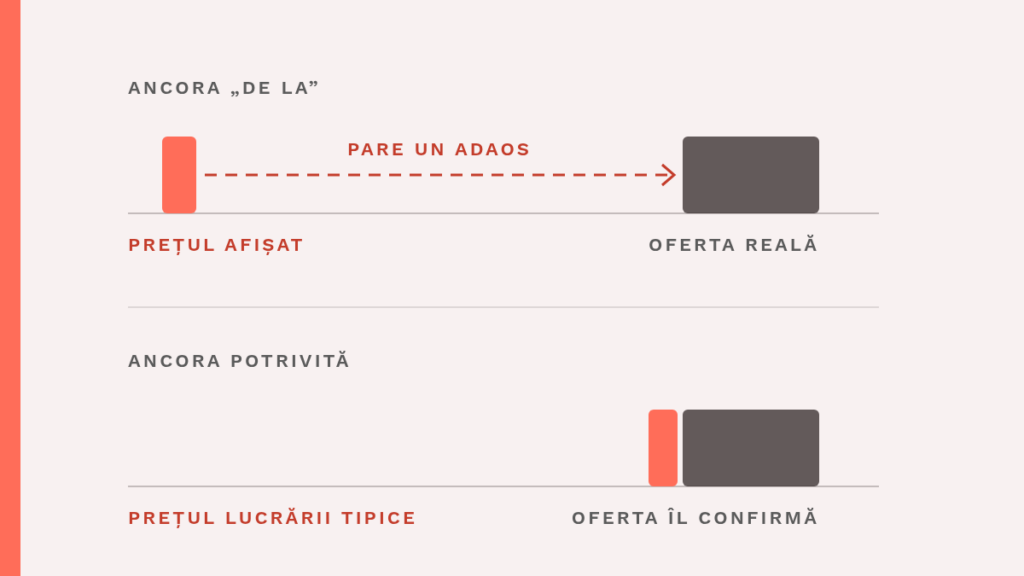
Think of a renovation firm that writes “from” on its site, followed by the price of the simplest package. The client who wants a full bathroom rebuild takes that figure as the reference, even if they know their job is larger. When the offer arrives, they set it next to that reference.
The gap between the anchor and the real offer looks like an add-on. You priced the offer correctly, with the labour and materials the job needs, but the client judges it from a number you chose for someone else. That is how a “from” price ruins the sale you wanted.
There is another effect, harder to see from the office. The low figure draws people for whom the minimum package makes sense, and it makes those who needed the full job hesitate. The client you wanted starts to wonder what will be added along the way, and that question sends them to the firm that showed the full price from the start.
4. When “from” helps you
A “from” price does its job when a real share of your clients buy the starter package itself. A garage that posts the oil-change price puts a figure on the site that many people pay as written. The anchor and the invoice match, and the client sees that the firm told the truth from the first number.
It also helps when the client needs to learn first whether they can enter the category. Someone who has never bought accounting services wants to know if they can afford even to ask, and an honest starting figure, with a list of what it covers, gets them to call.
You can check this from your invoices: put the “from” price next to the average sum paid by clients in recent months. If the gap is large, the anchor works against you.
5. The law already regulated one anchor
The European Union already addressed an anchor you see in every discount campaign: the old price, struck through, next to the new one. Directive (EU) 2019/2161 added Article 6a to Directive 98/6/EC. Any discount claim must show the prior price, meaning the lowest price the trader charged in at least the 30 days before the reduction.
The lawmaker started from the same observation as the psychologists above. The figure placed next to a price changes how the client judges it, so the directive decides which figure the trader may put there.
The “from” price in your offer remains a choice you make. It deserves the same care the law demands for discounts: the figure you show must say something true about what the client pays.
6. How you choose the first number in an offer
I start from a position I hold: “Clients buy the progress they make with a product. The product is only the path.”
For the client you want to help, the right reference is the price of the job that gets them there, with everything it includes. If you show that price first, the final offer confirms the reference, and the talk moves from what it costs to what they get.
When you keep “from”, write next to the figure what the client gets for that sum and who the package is for. Then the client can tell on their own whether the minimum package concerns them. A figure left without explanation works in a direction you did not choose.
Show the full package too, where you have one. The mind compares with the first price seen, so a full package placed first helps the client judge the middle package correctly, the one people like them usually buy. You use the same mechanism as the 1974 wheel, this time in the client’s favour.
At the end, check what reference your clients actually hold. Ask the last ones who bought what sum they expected to pay and where they saw it first.
“An hour with five real clients says more than a day of brainstorming in a meeting.” Brainstorming, the meeting where the team throws out ideas, gives you opinions about the client, and the client tells you where their figure came from.
What to keep
The first number in an offer becomes the reference against which the client judges the rest, and experience or a reward does not protect them from the effect. A “from” price helps only when the client you want actually pays that sum. Choose the anchor by the job your client usually buys, and write next to it what they get.
Brand Mentors
I work with companies through Brand Mentors
There I do brand strategy and consulting, starting from consumer psychology. You will find the services on brandmentors.ro.
Go to Brand Mentors