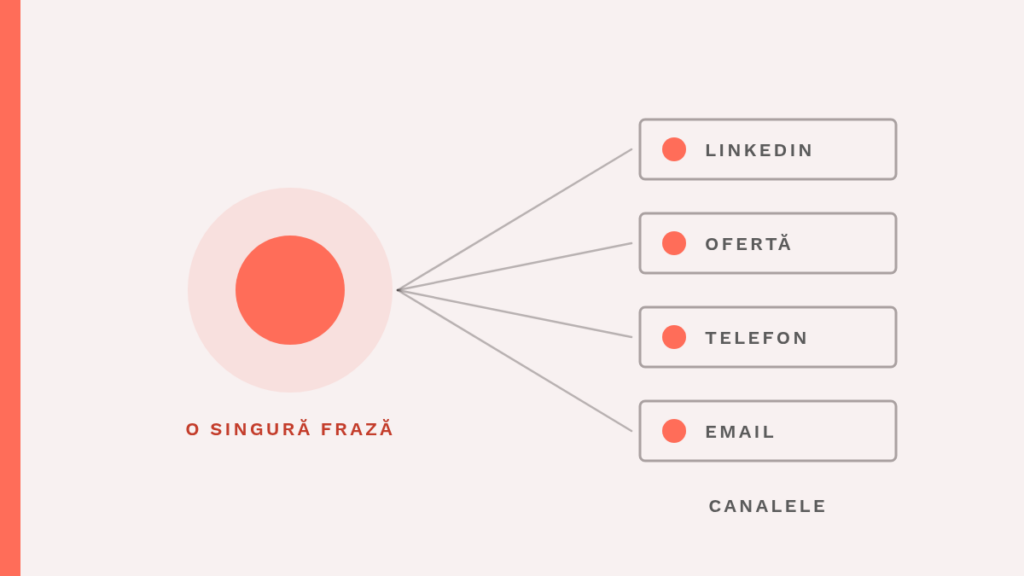
The line that has to hold on every channel says what your firm changes for the client, in words a person can repeat after they hang up. If your LinkedIn page and the proposal you send by email describe two different firms, the client keeps neither of them.
Many founders start from the channel: they open the company page, write the pitch for the proposal, then rewrite the copy for the site. Each text works on its own. Side by side, the texts read as if different firms wrote them, each with another reason to be chosen.
1. What the message means before the channel
The reverse order has a name: message architecture, the map with the brand’s main line and the proof that supports it, written before the first text for a channel. The main line sits at the top. Under it you place three or four proofs, and under each proof you place the examples you can show a client.
A good message stays the same on every channel. The channel only carries it.
Each channel asks for a length and a tone: a post has a few lines, a proposal has pages, and on the phone you have room for one sentence or two. The line at the centre of the map stays the same in all three, and you change only what you put around it.
2. How Salesforce started from one line
Marc Benioff, a former Oracle executive, founded Salesforce on 8 March 1999 with Parker Harris, Dave Moellenhoff and Frank Dominguez. The company’s history page quotes the February 1999 plan, which described it as “A World-Class Internet Company for Sales Force Automation”, a web firm for sales automation.
Salesforce writes that Benioff looked for a way to make business software easier to buy. From that idea came the NO SOFTWARE concept and logo, meaning “no software”. The launch then took the theme “The End of Software”, and the line named from the start what the client leaves behind when they choose Salesforce.
3. The same line, on three channels
Salesforce launched on 7 February 2000, at an event built around the theme “The End of Software”. The first channel was the stage, and the line gave it its theme.
The second channel was the street, outside a Siebel Systems conference, a firm that sold software for customer relationships. Salesforce hired actors who staged a protest there, with signs against software. The signs said, in other words, the same thing as the launch theme.
The third channel was a character. Bruce Campbell created SaaSy, the firm’s first mascot, a circle with arms and legs that wears the word “software” crossed out on its chest. Salesforce writes that SaaSy still shows up at company events and that it stands for the end of software.
4. Why the line held
The line fit on a placard, in an event theme and on a mascot’s chest, with no extra explanation. If your line needs a paragraph before anyone gets it, no short channel can carry it.
The line also named the alternative the client leaves behind: software that was hard to buy. That is how you build points of difference, what gets you chosen in a category, which I covered in the article on points of parity and points of difference.
Salesforce had the concept and the logo first, and the mascot came after them, as the company itself tells the story. It is the order I stand by: “A brand gets clear before any campaign.”
Wikipedia notes that Salesforce became known in those years through the slogan “the end of software” and through the campaign around it. The case still comes in large part from the story the firm tells about itself. Read it as a lesson in method, because it has no result figures you can check.
5. The test for your line, in four steps
First step: write the line in one sentence, with the client in it and with what they leave behind when they choose you. If you need three adjectives and two commas, you have not chosen what you say.
Second step: put the line in four places, one under the other: the LinkedIn page title, the first sentence of the proposal, what you say when you answer the phone, and the subject of an email to a new client. Then read them out loud, in that order.
Third step: find the place where the full line no longer fits. If the proposal pushes it onto page two, under the list of services, move it into the first sentence. If on LinkedIn you stretched it into a paragraph, cut until the opening sentence remains.
Fourth step: ask a client who has already worked with you to tell you, in their own words, what your firm does. When what they say matches the line, the map holds. If it does not match, rewrite the line from their words before you open another channel.
6. What you check before a new channel
A new channel, a TikTok account or an email newsletter, asks for new copy every week. Before you open it, pick from the map the proof you will take there and the example you will use to show it.
If you find no fitting proof, the channel pushes you to write about anything, and the main line gets lost among posts. Hold the channel until you find the proof.
Salesforce chose different channels, from a launch stage to a staged protest and a mascot, and each one carried the same line. You can do the same on a small firm’s budget if every channel gets the line, a proof and an example, in that order.
What to remember
Write the main line before the first text for LinkedIn, the proposal or the site, with what the client leaves behind when they choose you. Then put it on every channel and see where the full line no longer fits. When a client repeats it in their own words, you can take the line to a new channel.
Brand Mentors
I work with companies through Brand Mentors
There I do brand strategy and consulting, starting from consumer psychology. You will find the services on brandmentors.ro.
Go to Brand Mentors