A campaign report shows impressions, clicks and downloads, and the invoice you pay starts from the figures in it. You rarely ask who produced the numbers.
In September 2017, Uber took that question to a federal court in San Francisco. If you pay for online advertising, however small the budget, the story concerns you too.
1. What Uber claimed
Uber sued Fetch Media, a mobile marketing agency owned by the Dentsu group, which had bought its ads since 2014. According to CNBC, Uber accused it of wasting tens of millions of dollars on ads nobody saw or that never existed.
The total sum was not made public. For 2016 and the first quarter of 2017 alone, Uber said it had paid the agency more than $82.5 million.
The accusations had three layers. The first was an ad loaded on a page but unseen by any person, because it sat low where nobody scrolled or was so small the eye could not make it out.
The second layer was ads bought on sites that did not exist. The third, the hardest to catch, was app downloads counted as ad results even though the person had never clicked any ad.
2. What success looked like in the report
The contract said when Uber paid. Payment for an ad was due if, after seeing it, the person installed the app, was a new customer or took their first ride.
The agency sent data that showed more and more installs, and the budget grew with them. According to the complaint, as CNBC summarised it, monthly spend rose from less than a million dollars at the end of 2015 to more than six million dollars at the end of 2016.
I see here the part that makes fraud possible, more important than any technical trick. Whoever pays on a figure ends up sending more money exactly where the figure is easiest to inflate.
3. The customer who would have come anyway
Uber brought another accusation, harder to see than a site that does not exist. The company claimed that many new customers would have come anyway, because Uber was very well known, with or without the agency’s ads.
In the trade, the problem is attribution, meaning how you decide which ad gets credit for a sale. When the attribution rule gives credit to the last ad in the path, any install that would have happened anyway can show up in the report as a paid result.
I described in the article on how much you put on brand how another large company found that the report gave credit to the wrong place. At Uber, the same weakness had a beneficiary who collected money on each install.
4. What the agency answered
Fetch rejected the accusations. In a statement to CNBC, the agency called them unfounded and said Uber was trying to divert attention from unpaid invoices to the small suppliers through which the agency placed ads.
The agency also said it had helped Uber win more than 37 million new users since 2014. The CNBC article does not say how the case ended, and I did not open a source in this run that confirms the outcome.
That is why I read the case as a dispute with two versions, without picking one. For your budget, the question Uber asked matters, whatever the verdict was.
5. How much of an ad a person sees
The problem is old in online advertising. As early as 2004, George Reyes, Google’s chief financial officer, called click fraud the biggest threat to the internet economy.
The Media Rating Council, the American body that sets the standard for viewable advertising, requires half of an ad to be on screen for one second, or two seconds for video. The bar is low.
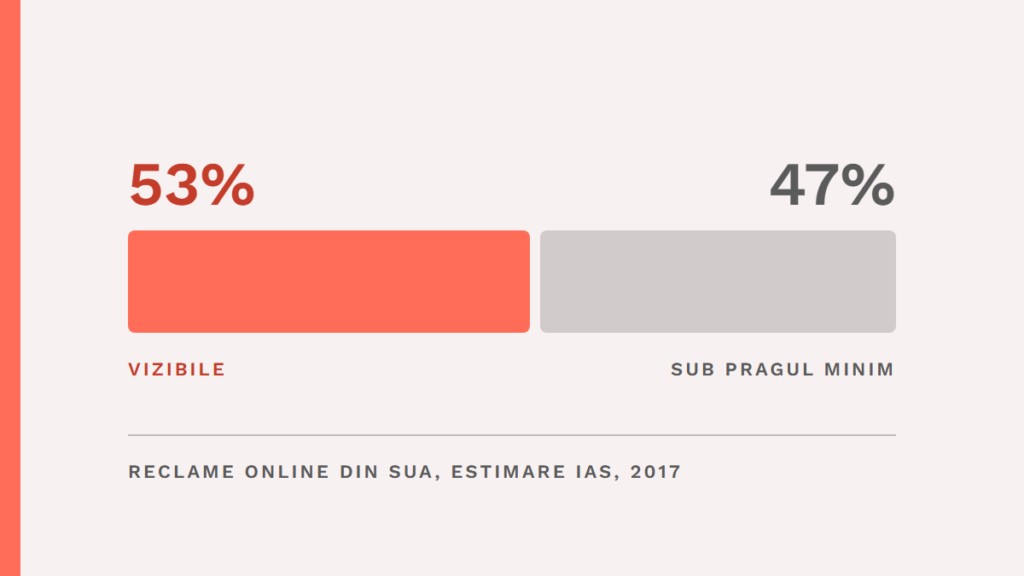
Even so, Integral Ad Science, an ad technology company, estimated at the time of the lawsuit that only 53% of online ads in the United States passed it. The rest did not even meet that threshold.
A large share of online advertising is bought automatically, through what the trade calls programmatic, meaning purchases made by programs, without a person choosing each site. So much advertising is bought every second that nobody can check each purchase.
6. The belief behind the report
A report that shows month-on-month growth produces a comfortable belief: the ads work, so they deserve more money. Uber’s budget grew for a full year on that basis.
The rule I propose for this topic goes like this: a marketing belief becomes a fact only after you have tried to contradict it. A campaign report becomes fact only after a test that could have contradicted it.
How to build a test of that kind I described in the article on how to tell if a marketing spend brings anything.
7. Four checks for your budget
The first check is the list of places where your ads appeared. Ask the agency for it or pull it from the ad account, and if you do not recognise a good share of the sites and apps, you have a question to ask before the next invoice.
The second check concerns the event you pay for. A click or an impression is easy to fake, while an order, a phone call or a form with real details is much harder to fake, so tie payment to the event that is hardest to manufacture.
The third check compares two sources that should say the same thing. Put the ad report next to the figures from your own system, from site visits to orders at the till, and if the gap between them grows with the budget, you have a sign that someone is inflating the report.
The fourth check answers Uber’s accusation about customers who would have come anyway. Pause advertising for a period in one area or on one product and watch whether sales fall as much as the report says.
You can do all four without a specialist and without a large budget. Treat the report of whoever you pay as a claim that can turn out to be wrong.
What to remember
An ad report is written by someone who gains from its figures, so you check it against data from your own system. Pay for events that are hard to fake and ask for the list of places where your ad appeared. When the budget grows with the report, run a test that could contradict it before you put in more money.
Brand Mentors
I work with companies through Brand Mentors
There I do brand strategy and consulting, starting from consumer psychology. You will find the services on brandmentors.ro.
Go to Brand Mentors